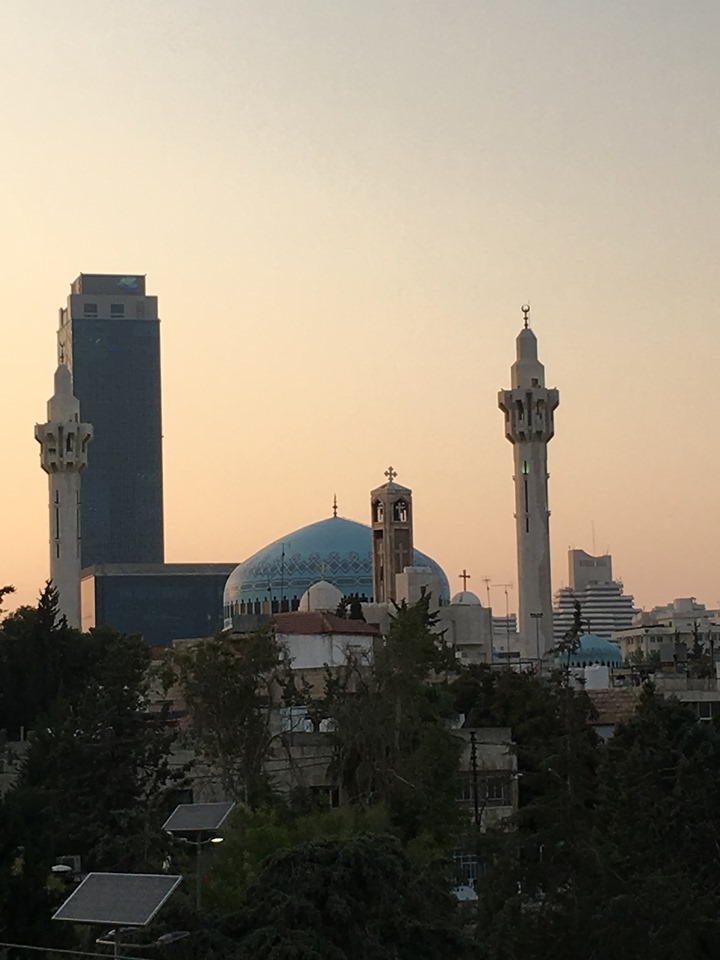
A Tour of Biblical Jordan

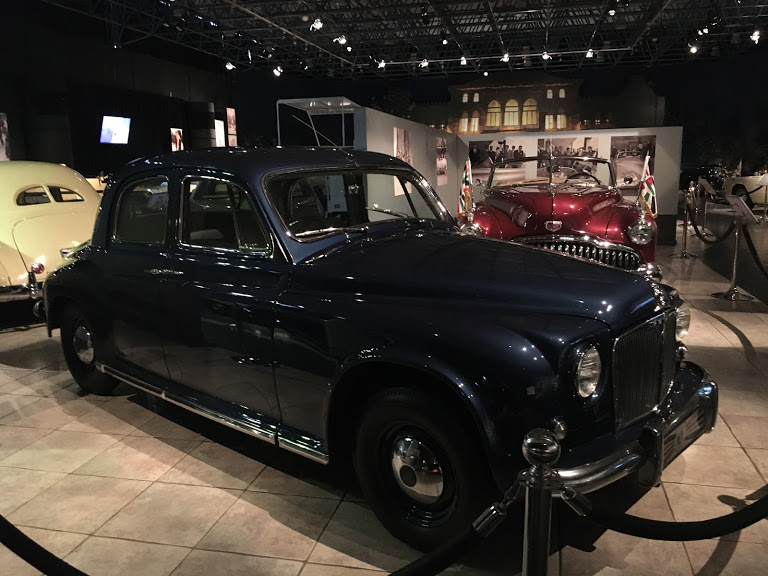
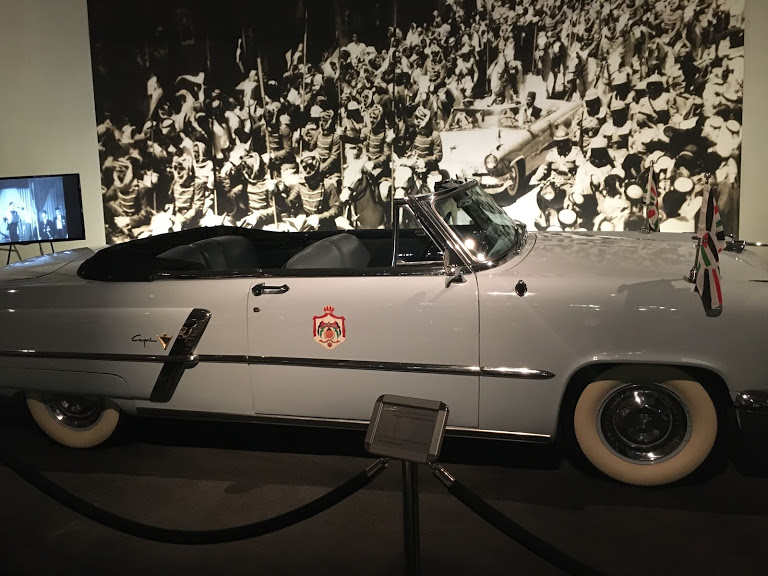
October 27th, 2019 – Before I talk about Biblical Jordan, I have to share some photos from the coolest museum in Amman: the Royal Automobile Museum, which houses the collection of the Royal Family’s classic cars. Most of the cars belonged to the late King Hussein, who was an avid collector of vintage cars.
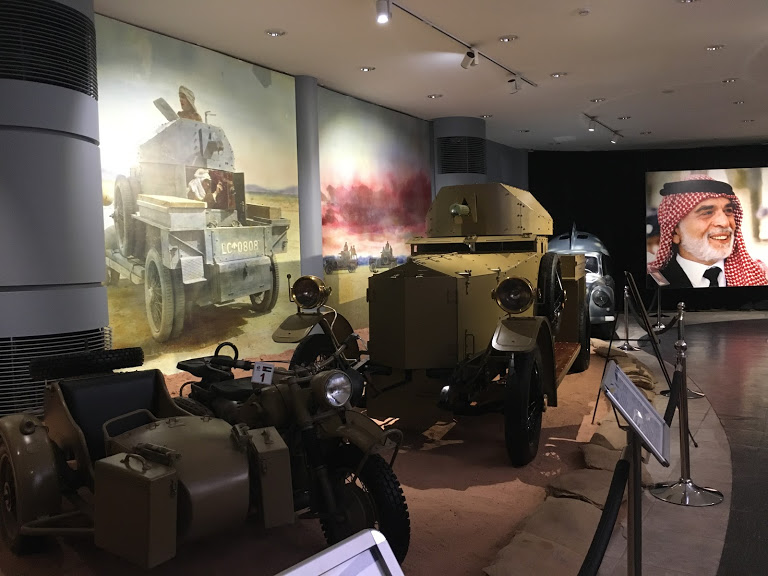
A motorcycle used during the North Africa campaign of World War II and an armored vehicle used during the Great Arab Revolt
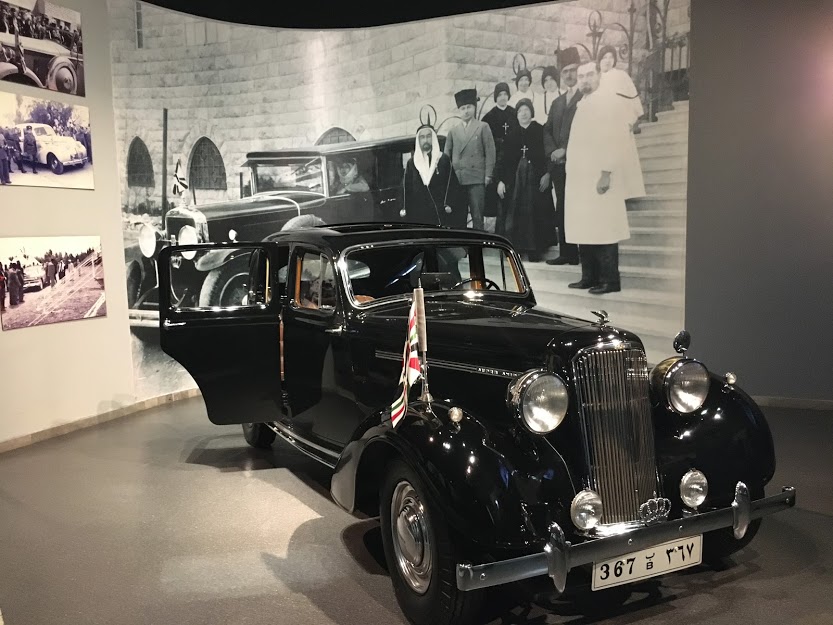
One of the first official cars of the Royal Family of Jordan, acquired by King Abdullah I
King Hussein’s first personal car
Another official car of the Royal Family used by King Hussein during official appearances
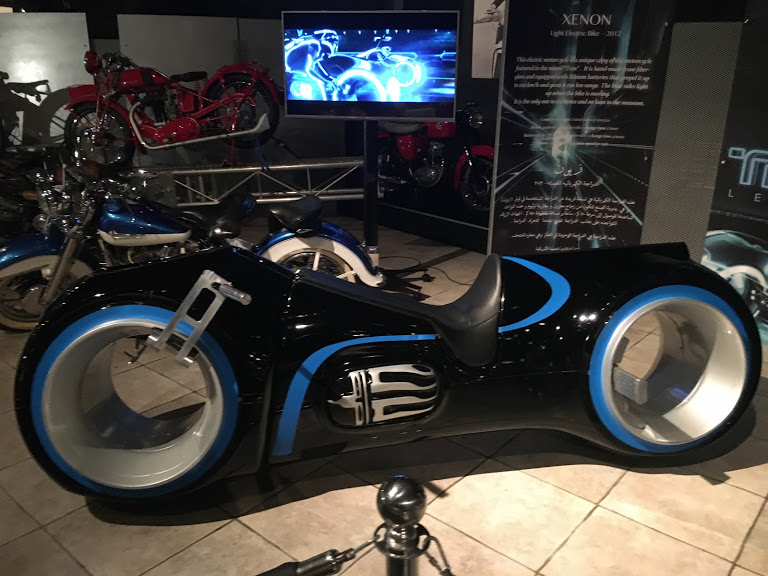
A fully functional motorcycle based off the Tron Light Cycle. This motorcycle is the only one of its kind and is on loan to the museum from the US.

On Friday, CIEE gave us the opportunity to take a tour through Biblical Jordan. The day began with a stop in Madaba to see the mosaic map in St. George’s Orthodox Church (I visited this map earlier in the semester. Check my post on Madaba to see pictures of it!). After Madaba, CIEE took us to Mt. Nebo, which is only about 20 minutes from Madaba. Mt. Nebo is the site where Moses looked out over the promise land, and, according to some interpretations, was buried (Deuteronomy 34). Somewhere near Mt. Nebo, supposedly, is where Jeremiah hid the Ark of the Covenant (2 Maccabees 2). However, this story conflicts with other stories about the Ark’s location in the Old Testament (compare with 1 Esdras 54*; Note that Esdras is considered non-canonical by Jews, Catholics, and Protestants).
Side note: we were informed by our guide that Mt. Nebo was completely closed 20 minutes before we arrived because former President George W. Bush was there!
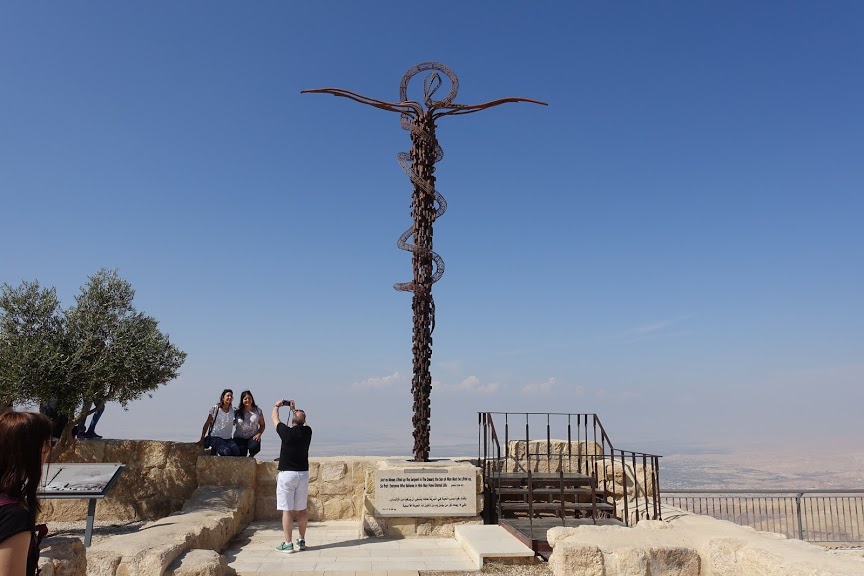
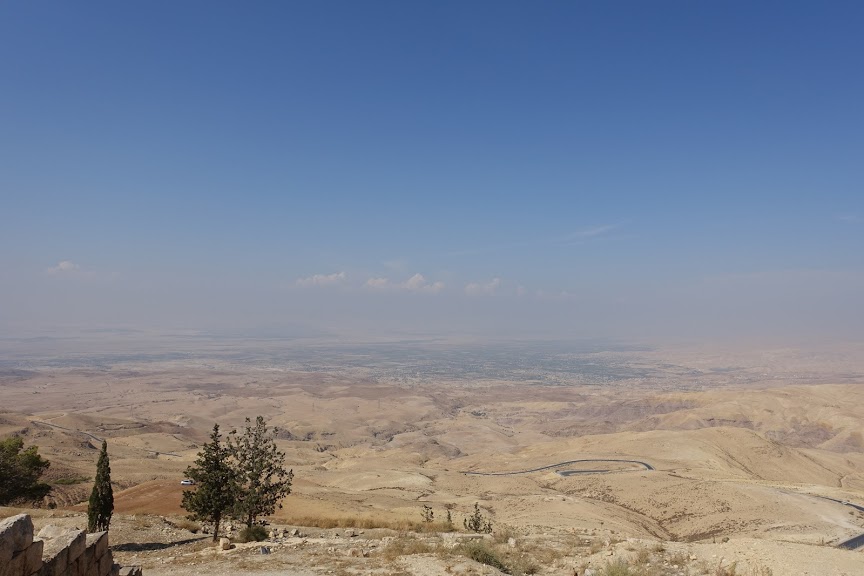
The large serpentine cross atop Mt. Nebo. The inscription beneath it is from John 3:14-15: “Just as Moses Lifted up the Serpent in The Desert, the Son of Man Must be Lifted Up, So that Everyone Who Believes in Him May Have Eternal Life.”
The view of the Promise Land. On clear days, you can see all the way to Jerusalem!
“This is the land I promised on oath to Abraham, Isaac and Jacob when I said, ‘I will give it to your descendants.’” (Deuteronomy 34:4).

After Mt. Nebo, we traveled 45 minutes towards the Dead Sea to the Baptism Site. The Baptism Site lies on the border between Jordan and Israel-Palestine, as the Jordan River serves as the natural border. The baptism site was thought to be lost after the churches built on the site were destroyed centuries of earthquakes and destructive conflicts. The only clue archaeologists had about its location came from local legends of what the site looked like and John 1:28, “This happened in Bethany across the Jordan, where John was baptizing.” It wasn’t until the Mosaic Map was uncovered in Madaba that a structure near the Dead Sea that fit the descriptions of local histories was confirmed to be the Biblical Bethany.
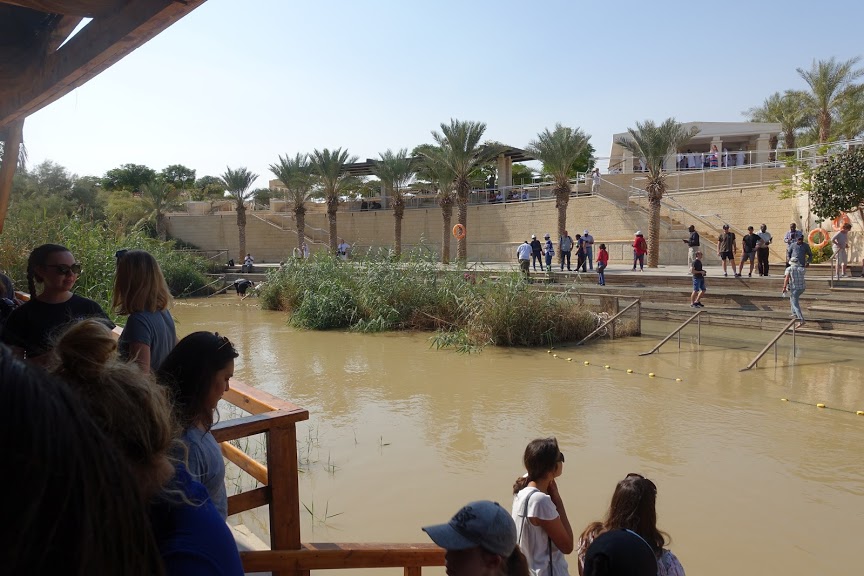
The Baptism Site and the border between Israel-Palestine and Jordan.

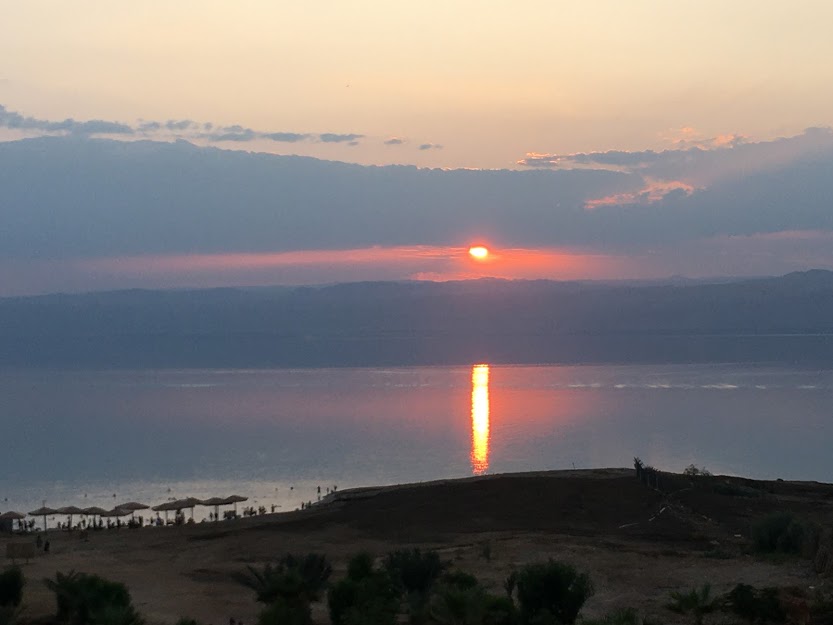
After leaving Bethany, we headed to the Dead Sea for the remainder of our evening (You can also read about the Dead Sea in my earlier Madaba post). Before we left, I was able to take a photo of the most beautiful sunset over the Dead Sea.
In other news, it is starting to get cold in Amman. For the past week I have been wearing long-sleeves and sweatshirts to class and sleeping under blankets at night. The average daily high is about 71 degrees (which is still cold because of the lack of humidity and constant breeze) and average lows about 57 degrees. I also think I’m starting to come down with a cold (I guess it was good that i was forced to bring cold medicine by my mother), but that won’t stop me from pursuing more adventures! Thanks again for reading!

-Matt
Fall Break 2: Beirut

October 21, 2019 – I didn’t tell many people that the second half of my fall break would be spent in Beirut, Lebanon because I didn’t want people to worry. For many people of an older generation, talking about Lebanon revives memories of Tom Brokaw, Peter Jennings, and Dan Rather reporting about the civil war that devastated the country throughout most of the late twentieth and early twenty-first century. This often restrains people from traveling to Lebanon, and thus they miss out on much of its beauty.

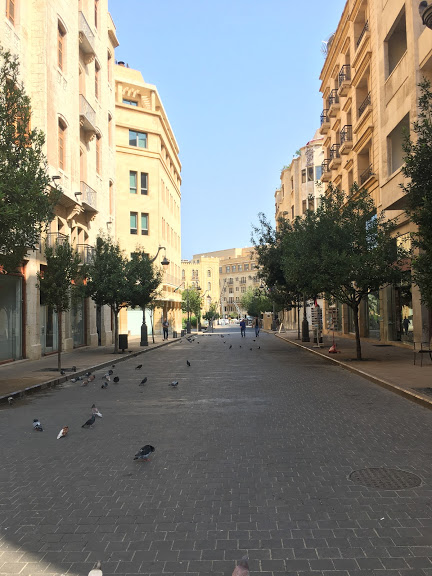
We used our first day in Lebanon to explore Beirut. To be completely honest, it would be a great folly if I attempted to describe Beirut’s beauty with my words. The architecture the city leaves you truly speechless. Unlike most post-colonial states, Lebanon (once the French mandate of Lebanon) embraces its history with the French and blends it with Arab traditions to make something truly unique.

One of the streets in downtown Beirut. The streets of Beirut are much cleaner, wider, and accessible than those in Amman.
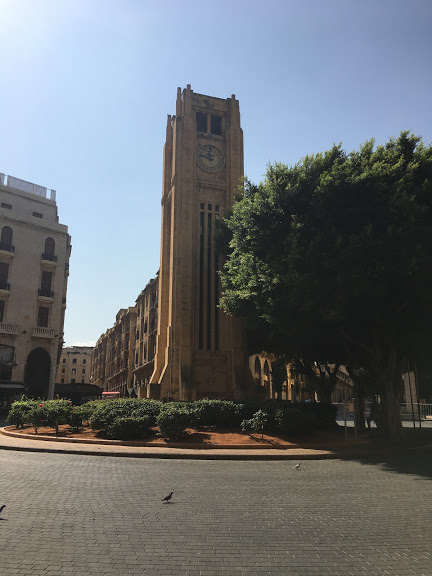
The famous clock tower in Beirut’s central district. We were astonished to find that the 4 clocks were Rolex!
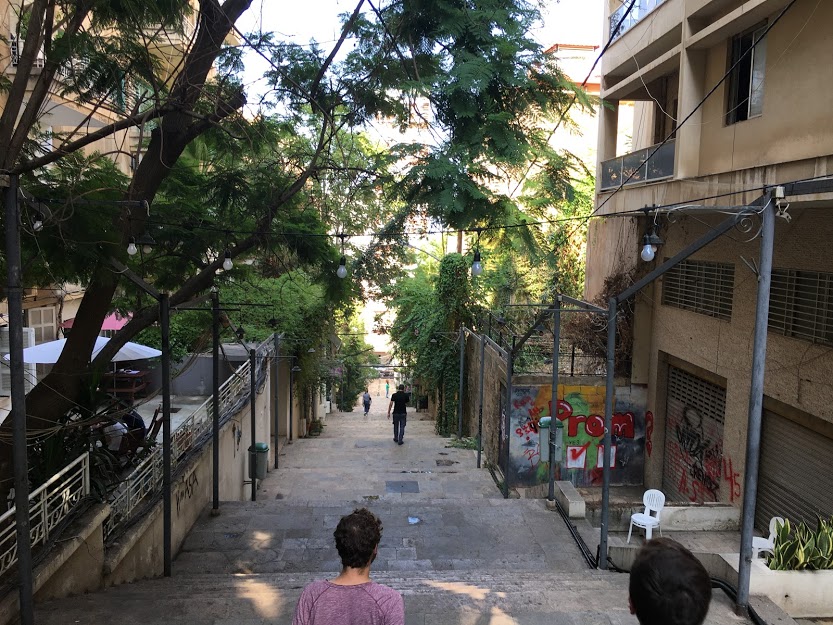
The Saint Nicholas Stairs, a famous passageway to the Sursock Museum
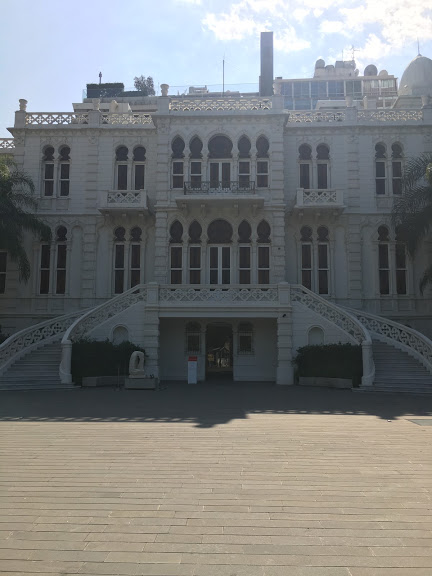
The Nicholas Sursock Museum, a privately funded museum in downtown Beirut. We enjoyed viewing the Picasso’s on display
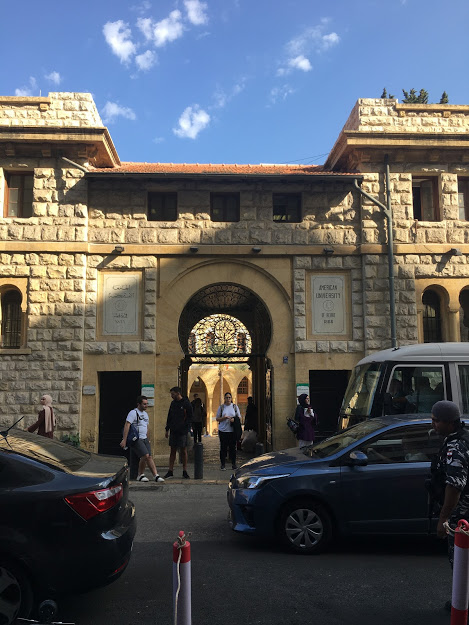
The main gate of the American University of Beirut, one of Beirut’s premier universities (I bet it brings back memories for you, Dr. Goldschmidt! Thanks for being a faithful reader of my blog!)

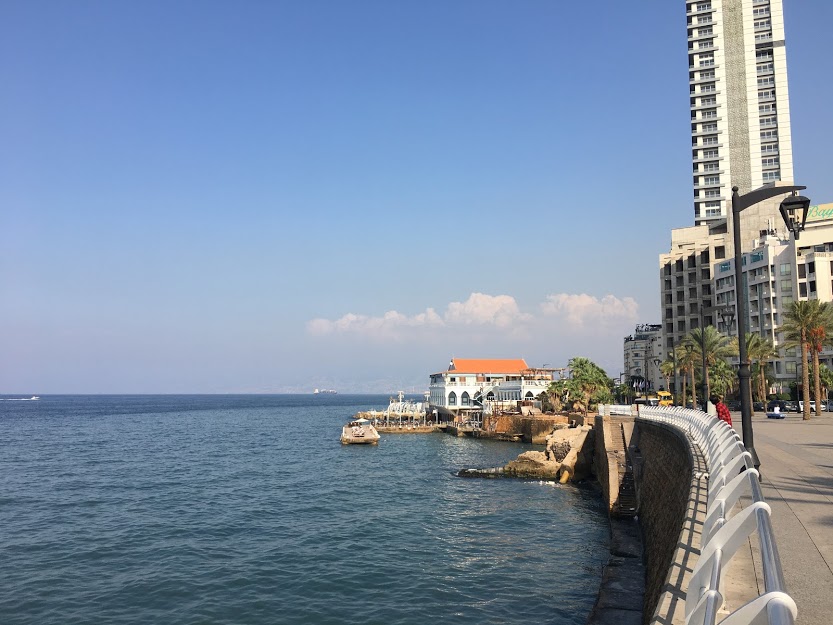
While the architecture was amazing, the city buzzing with life as people went about their daily commute, we ventured out of downtown back to our home neighborhood of Hamra to walk along the Mediterranean. While walking out of downtown, the Francophone vibe changes to something similar to South Beach, as large hotels filled with tourists from Europe loom over the coast. Yet, the views of Beirut on the water still take your breath away. It’s almost as if the Mediterranean itself commands a reverent silence, so you can fully appreciate the moment you’re in.

I’ve never been a beach-goer, yet the Mediterranean made me want to relax by its shores as long as I possibly could
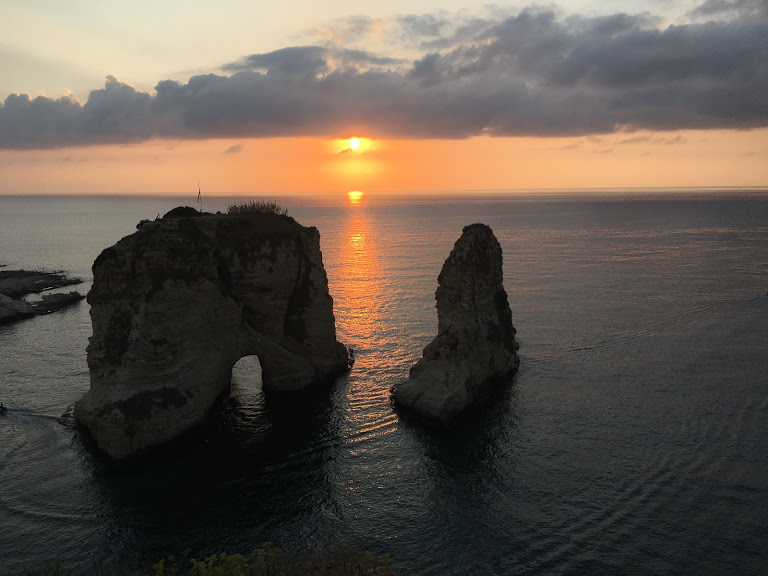
One of Beirut’s most famous natural landmarks, Pigeon Rocks, at sunset

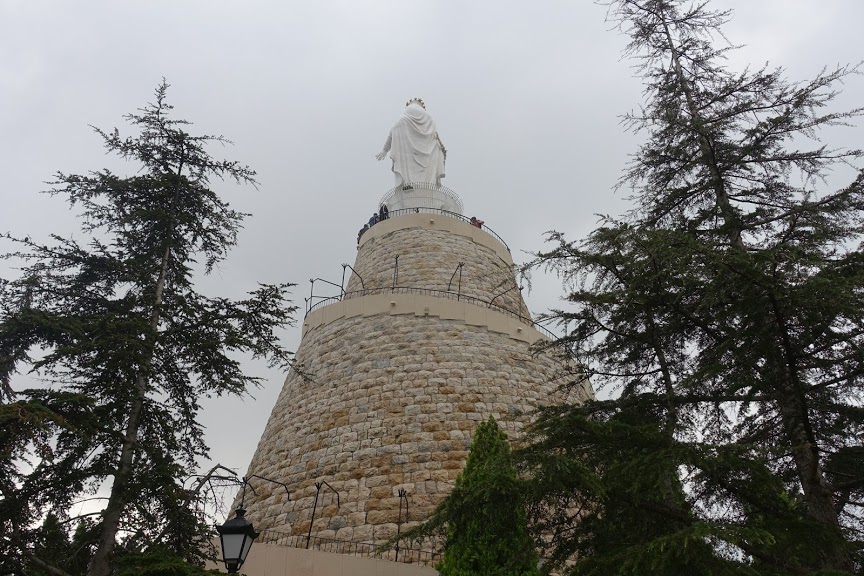
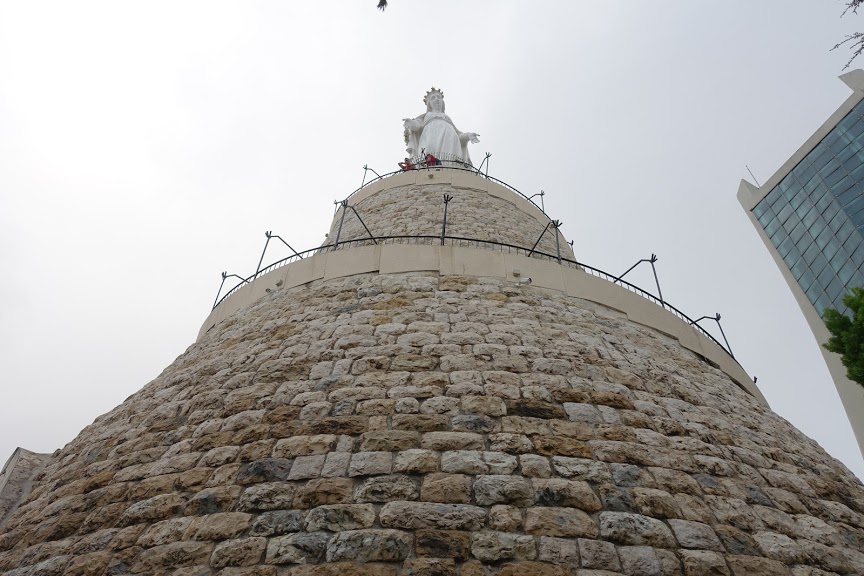
The following day we ventured to Harissa to visit the shrine of Our Lady of Lebanon. Our Lady of Lebanon is a Christ the Redeemer-esque statue of the Virgin Mary that overlooks the city beneath it. The site is maintained by the Maronite Catholics of Lebanon (the country’s largest sect of Christianity). It’s a tad bit of a climb to the statue, but it was absolutely worth it to see this landmark.

The statue of Our Lady of Lebanon from the entrance to the shrine
Another view of the statue
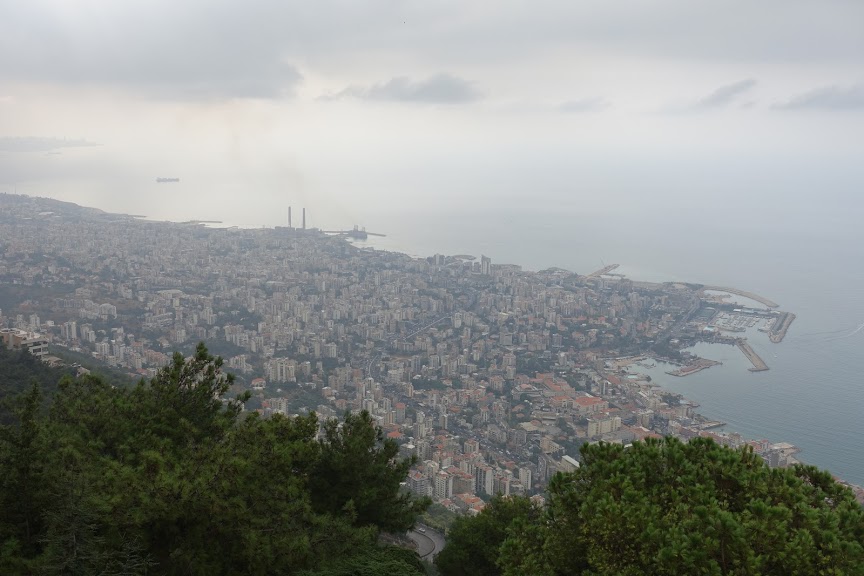
The view of the city from Harissa

Despite the beautiful sites, one cannot forget about Lebanon’s tumultuous history. Lebanon was devastated by a civil war between 1975 and 1990 that destroyed, divided, and weakened the nation. After the civil war, Prime Minister Rafik Hariri put the country on a path to recovery, restoring downtown Beirut with many of the sites that remain there today, while the Syrian military occupied most of the country after becoming involved in the civil war in 1976. In 2005, Hariri was assassinated in Beirut. An investigation by the UN claims the assassination could be linked to the Syrian government and Bashar al-Assad, as Syria would have benefited from a weak-Lebanese state and grew concerned with Hariri’s recovery plans. The assassination triggered a brief period of violence again with the Cedar Revolution, which forced the Syrian military to withdraw from Lebanon.

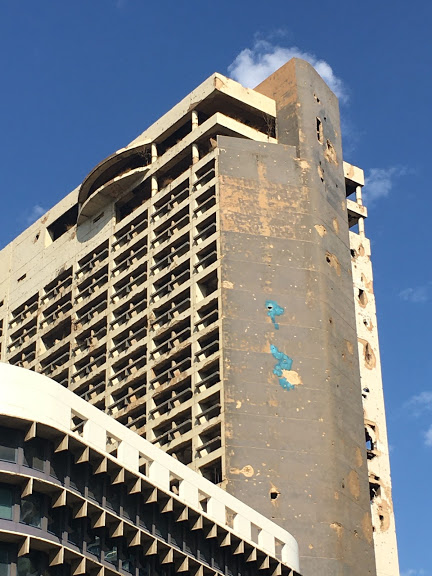
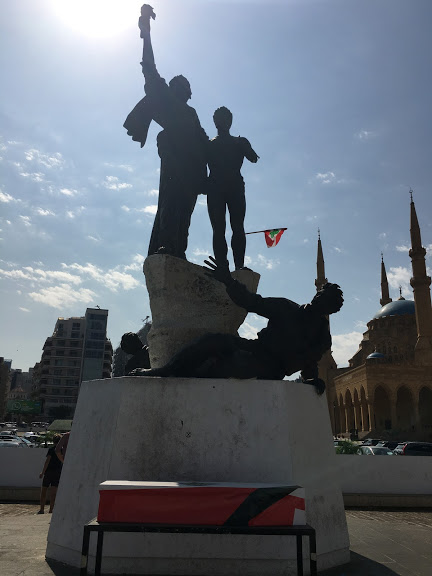
Lebanon purposely leaves reminders of the civil war standing around the country. In Beirut, two of the most famous reminders are the old Holiday Inn and Martyr’s Square.

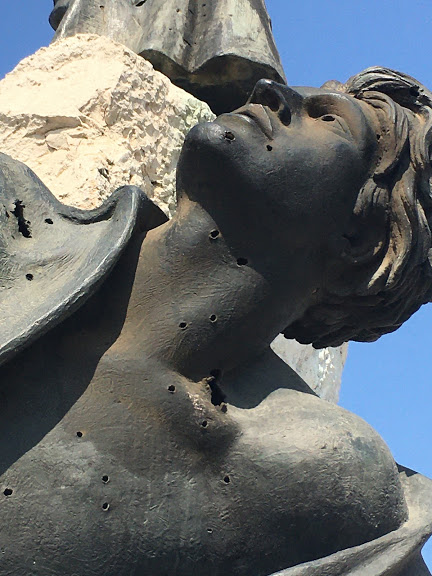
The old Holiday Inn stands tall above downtown Beirut. The hotel was of major strategic importance during the civil war. Today, all that remains is the bullet-riddled skeleton that serves as a parking base for the Lebanese military

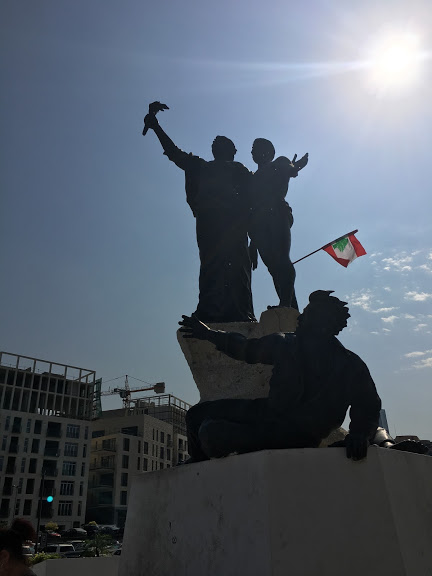
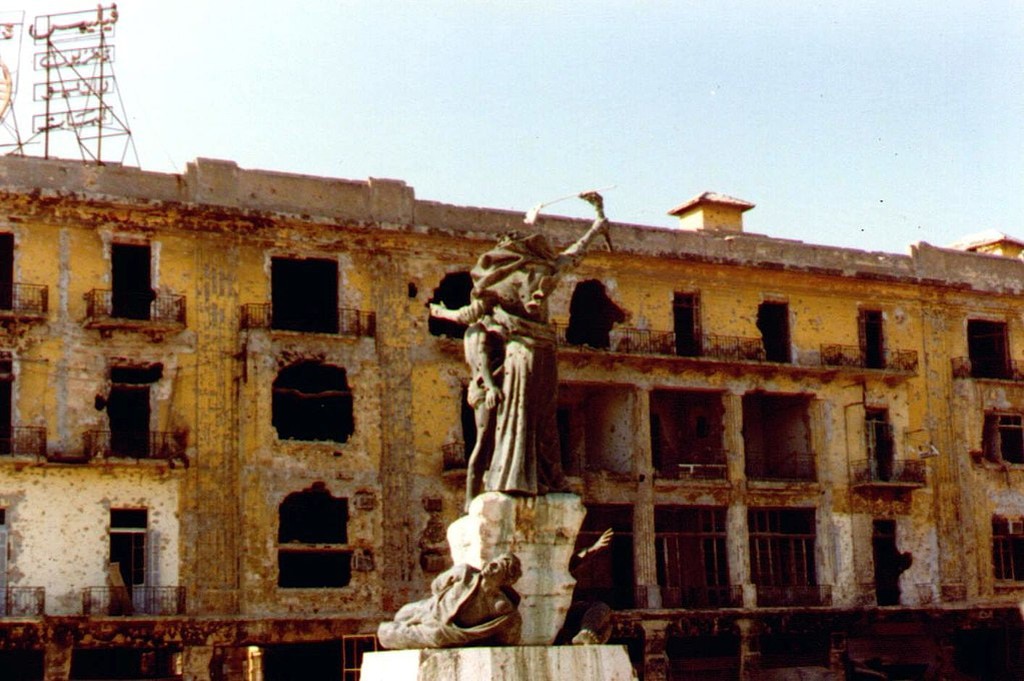
Martyr’s Square is my favorite monument in Beirut because of it’s history and harrowing solemnity. The monument stands on the spot where the Ottomans performed public hangings of Lebanese revolutionaries during the Great Arab Revolt. In 1931, the square was officially renamed Martyr’s Square as a memorial to those executed on the spot. During the civil war, the square served as the border between East and West Beirut, each controlled by different militias. The statue that sits at the center of the square was partially destroyed in 1982, but restore by Prime Minister Hariri during the restoration of Beirut. Today, the square is the location for most protests that occur in Beirut.

The memorial also features a coffin draped with the Lebanese flag, seen in front
Another view of the memorial
The memorial in 1982 during the Civil War
Source: Wikimedia Commons
The restoration of the memorial intentionally preserved some of the damage from the civil war

By the end of my travels, I realized something. Sitting at gate 19 of Rafik Hariri International Airport, waiting for my flight back to Amman that had been delayed for 3 hours, I thought to myself “I just want to go home.” By home, I didn’t mean the Moscow or Elizabethtown, I wanted to go back to Amman. I didn’t realize how much Amman has come to feel like home until yesterday. After classes, I was waiting for my Uber, and, as I sat on the sidewalk, I felt calm. I didn’t have the same anxieties of being in a new place and constantly aware of what’s going on around me like in Beirut or Oman. Amman felt comfortable. Amman felt like home, and I’m so happy to be back home.
Thanks for reading.

-Matt

Fall Break 1: Oman

October 14, 2019 – Last week was midterms which mean this week was the something we’ve all been waiting for: fall break! My friends and I packed up and headed to Oman. Oman is a gorgeous country on the Gulf that is relatively unknown by Western tourists.
A brief history of Oman: Oman has been inhabited since prehistory, and a distinct Arab culture has developed over millennia. After the fall of the Umayyad Caliphate, the Omanis established the Imamate of Oman as their first Islamic system of government. After a period of being ruled by the Nabhani Dynasty, the Portuguese captured Muscat and controlled it and other coastal cities until the Ottomans reconquered them in the 16th century. Following the reconquest of Muscat, the Omanis established a large trading empire from Bahrain to Mozambique. For a short period of time, the Sultan moved the capital of Oman to Stone Town, Zanzibar. After almost a century of British protectorate status, Oman became an independent state in 1951, with the modern Sultanate of Oman being established in 1970.

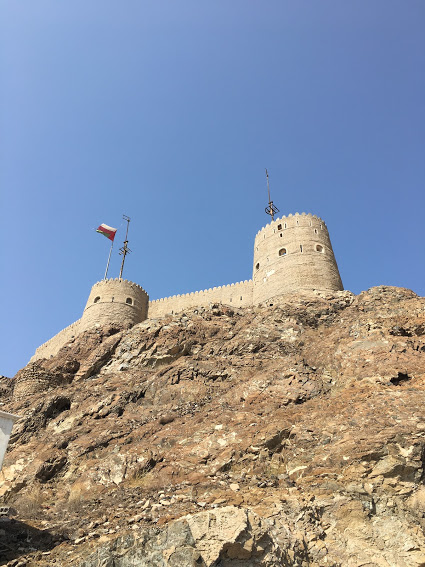
Muscat has scattered remains of the Portuguese forts all over the old city

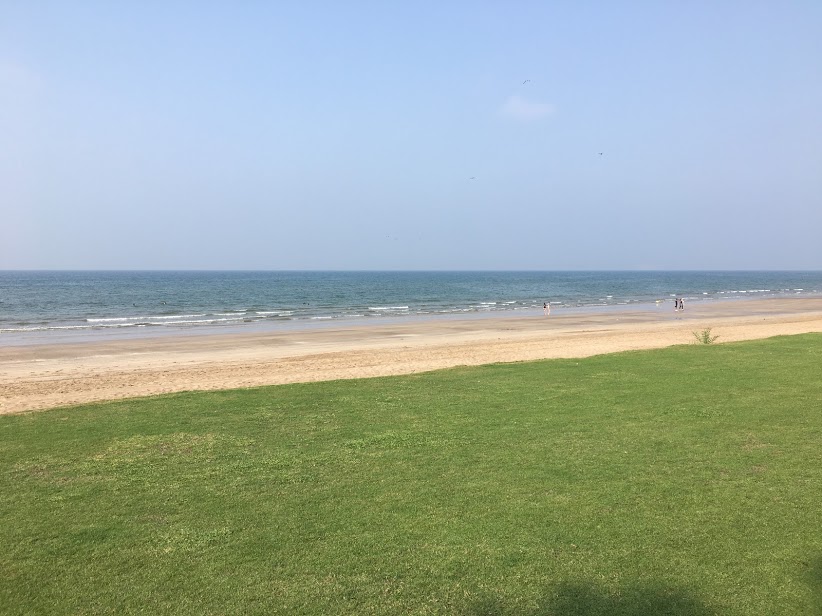
Our first day in Muscat was a beach day. We slept in, had an amazing lunch by the beach, and then relaxed the rest of the day. We even met some Egyptians on the beach and spent the day with them!

The beach in Muscat

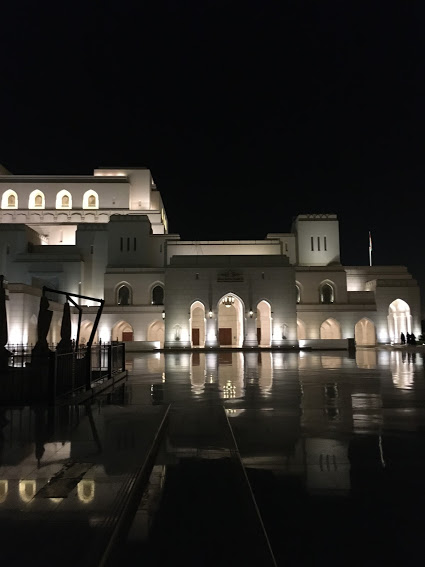
That night, we went to see the Royal Opera House, one of Oman’s most famous attractions, at night. The views were astounding, and the marble floors are kept immaculate by staff that works around the clock to keep them clean. It truly shows the wealth that Oman’s oil brings to its economy.

The Royal Opera House

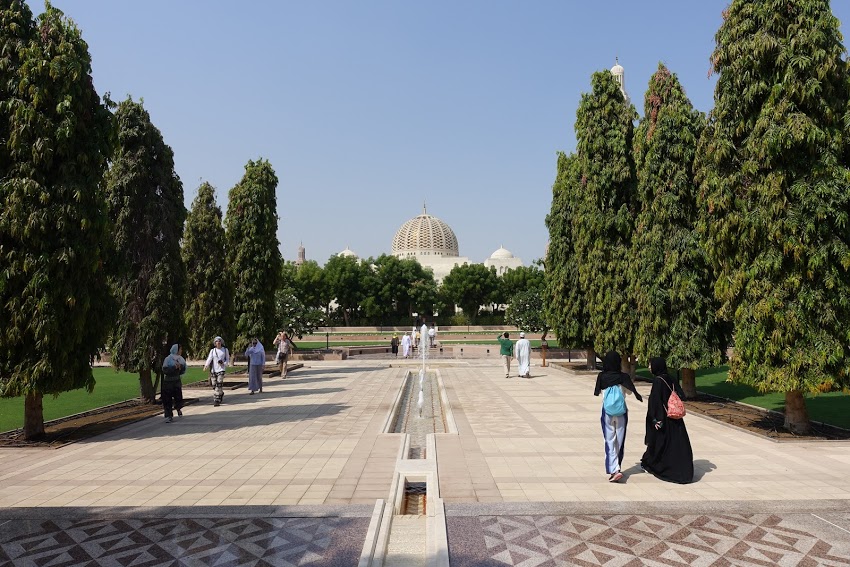
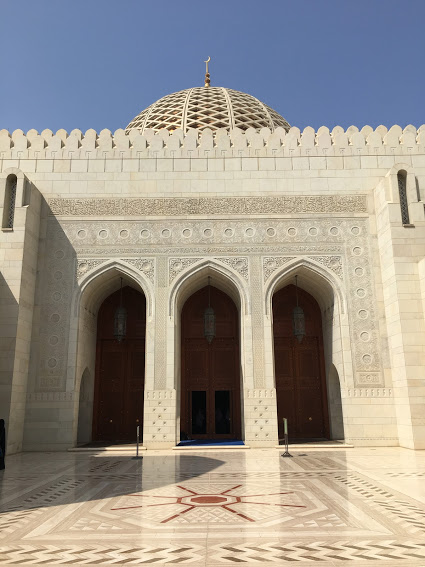
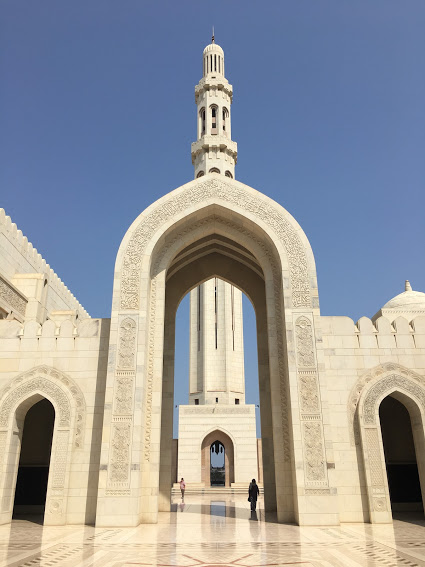
The following day, we did more sightseeing around Muscat. Our first stop was the Grand Mosque of Sultan Qaboos. The Sultan Qaboos Mosque is probably one of the most beautiful structures I have ever been inside of. The Mosque’s construction began in 1993, and it opened for worship in 2001. One of the largest Mosques in the Arab World, it can hold 20,000 worshipers. When you enter the Mosque, it’s sandstone and marble structures glitter and shine with the sun. The garden also provides a quiet, calming place to meditate and observe the amazing architecture.

The Mosque’s expansive courtyard and garden
The exterior of the main prayer hall
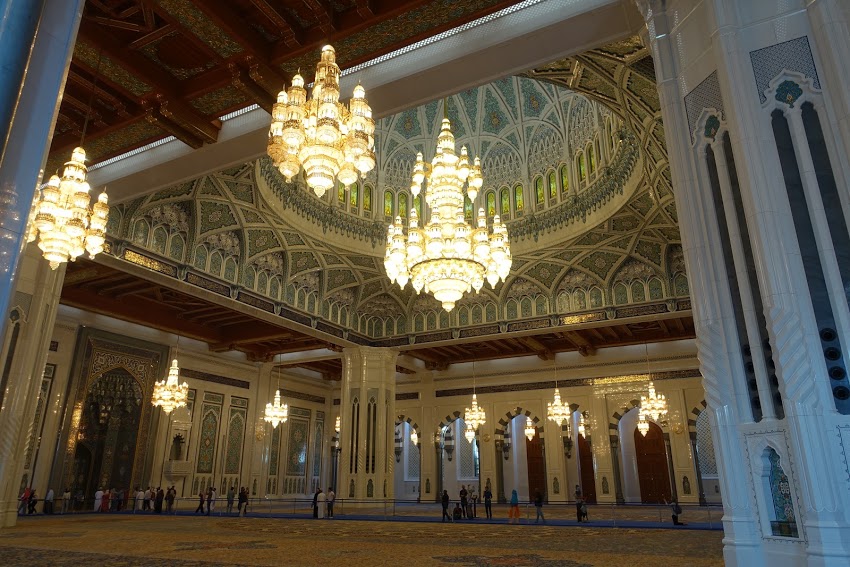
The interior of the main prayer hall, complete with ornate calligraphy, tile work, and custom made Iranian carpets.
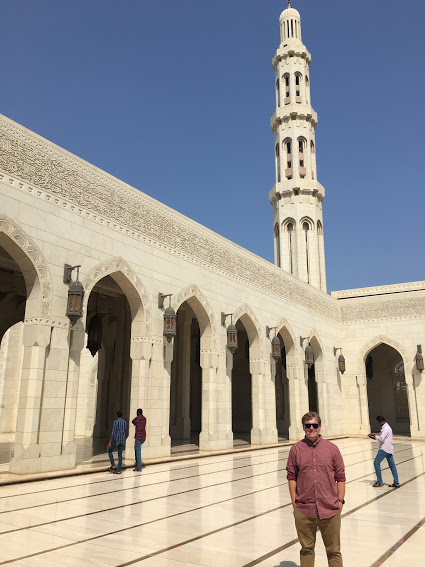
The largest minaret of the Sultan Qaboos Mosque
A picture for size comparison

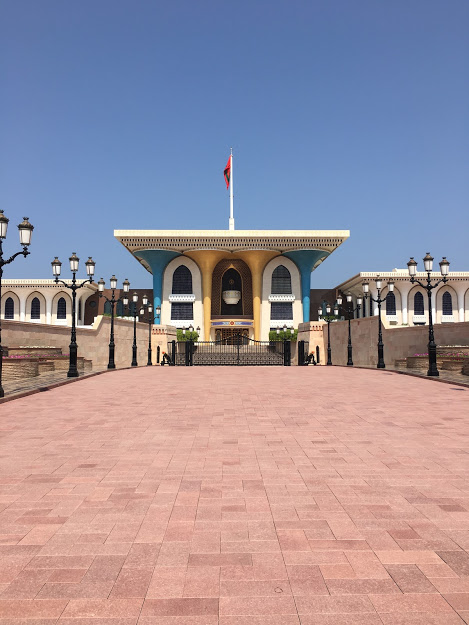
After the Mosque, we used our rented car to get across the city to the older district of Muscat: Muttrah. Muttrah houses the Al-Alam Palace, the National Museum of Oman, and the Muttrah Souq. The Al-Alam Palace is the traditional place of the Sultan of Oman. Today, it is used to house official state visits.

Al-Alam Palace

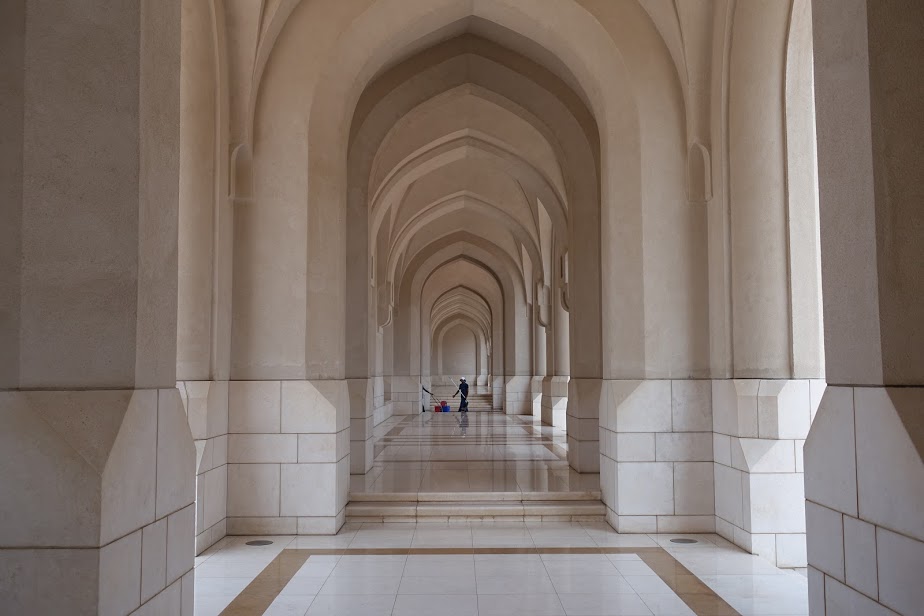
On the walk from the palace to the museum, I stopped to take a picture of Oman amazing architecture, employing the use of arches, sandstone, and marble. I don’t know why, but something about it makes you stop and just observe its majesty in silent awe.

The tremendously beautiful arches on the walk from the Palace to the Museum of Oman

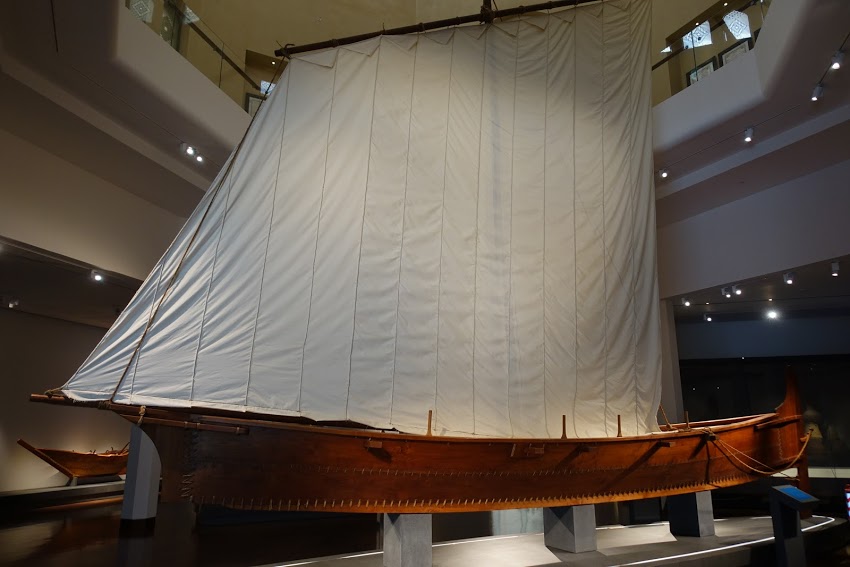
The National Museum of Oman holds many exhibits on Oman’s rich history and its relations with outside nations. I won’t bore you with the details or photos of the exhibits, but the exhibit on Oman’s maritime history. Oman’s greatness was possible because of its strong commercial naval power in the Gulf of Oman. In the center of the exhibit hall, the museum displays a replica of a ship built and used in Oman during its earliest days of maritime trading.

Oman’s shipbuilders were highly coveted across the region for their unique and innovative designs

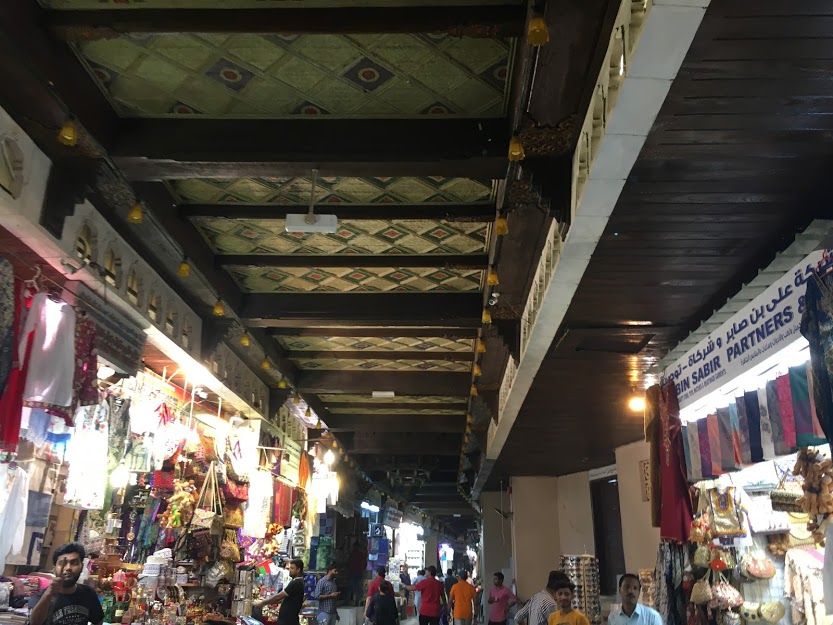
Our final stop of the day was the Muttrah Souq. The Souq is believed to be one of the oldest in the Arab world, and currently houses many shops that sell everything from Omani incense and daggers to everyday items like paper and dates. It’s easy (and fun) to get lost in the Souq, and explore all it has to offer.

My only photos of the organized chaos that is the Muttrah Souq

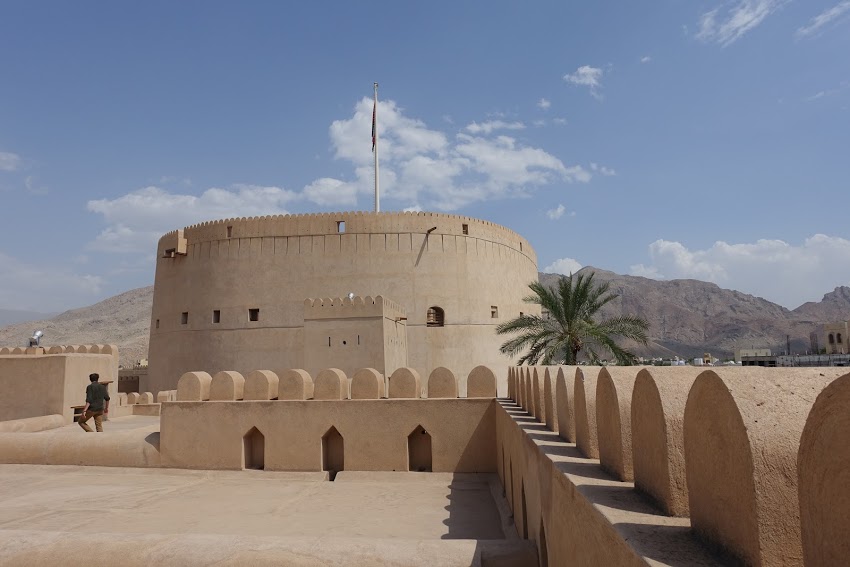
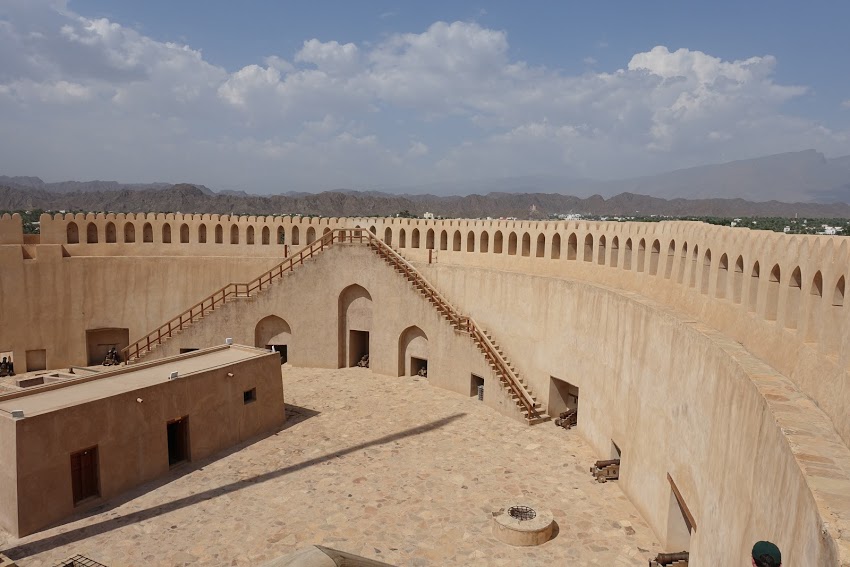
The next day we drove to Nizwa to tour the fort and castle there. The Nizwa Fort dates back to 17th century, and was actively used as a military fort until the 1980s. The fort features more of Oman’s amazing architecture, with beautiful sandstone, and high vantage points to view the city.

Nizwa Fort from the roof of an adjacent building
The fort’s interior

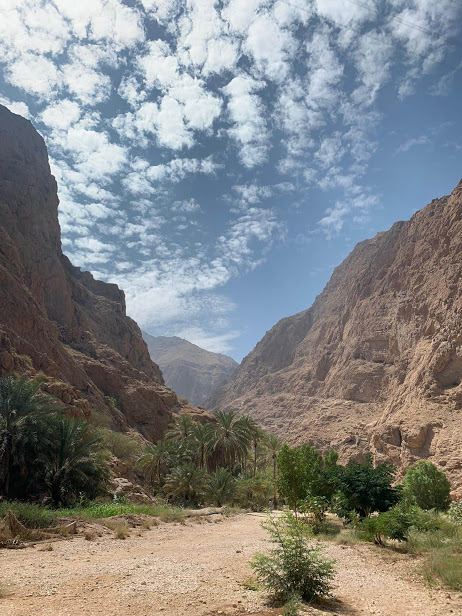
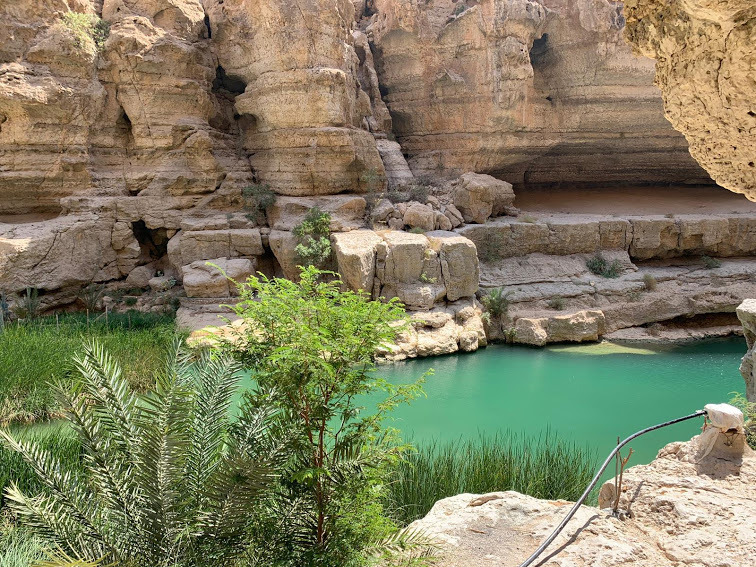
Today, we traveled down south to Wadi al-Shab and the Bimmah Sinkhole. Our roadtrip soundtrack featured some of history’s greatest hits including Rick Astley’s Never Gonna Give You Up, John Denver’s Take Me Home, Country Roads, and Phil Collins’s In the Air Tonight. Wadi Al-Shab (literally “Valley of the Young Man”), has some of the most beautiful nature I’ve ever seen.

Wadi Al-Shab on the trail in
Wadi Al-Shab’s beautiful blue water
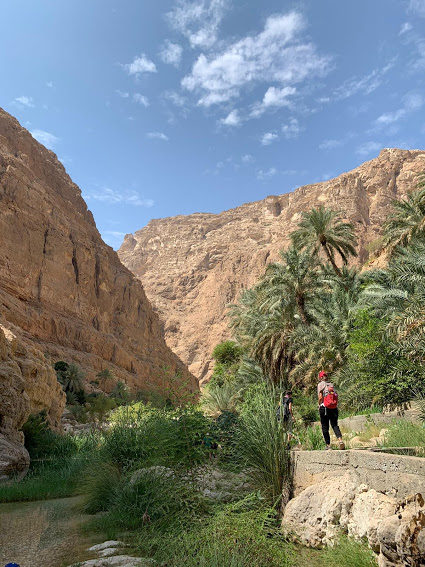
The valley gives amazing views of the mountains in Oman’s interior

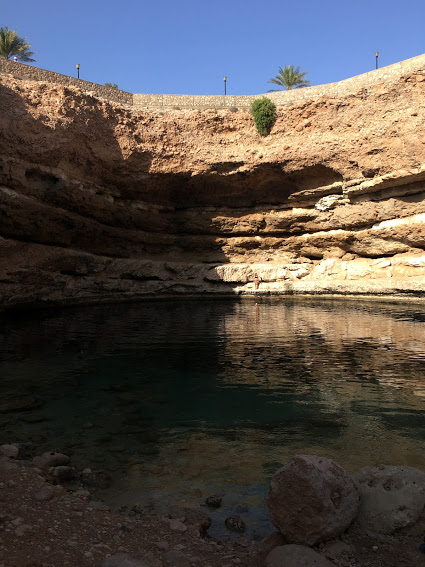
The Bimmah Sinkhole is a natural sinkhole 20 minutes away from Wadi Al-Shab. Visitors are allowed to swim in the sinkhole for free, so why wouldn’t we take the opportunity?!

We climbed the rocks across the sinkhole and jumped off them!

Now I’m back in my Airbnb in Muscat. I’m so excited to see what the rest of this trip has in store, check back soon for another update!

-Matt

The Olive Harvest in Ajloun

October 5th, 2019 – Much like in the US, October is harvest season in Jordan. As a cultural excursion, CIEE gave us the chance to travel North to Ajloun to assist some locals with the olive harvest. Ajloun is about an hour North of Amman, home to Ajloun Castle and two churches to the Prophet Elijah, as it is believed Elijah was born near Ajloun and lived there for a period of time.
We arrived around 11:00 AM and loaded into the beds of pickup trucks that would take us to the trees we would harvest. Most of the olive trees in this region were planted by or before the Romans, making them over 2,000 years old!

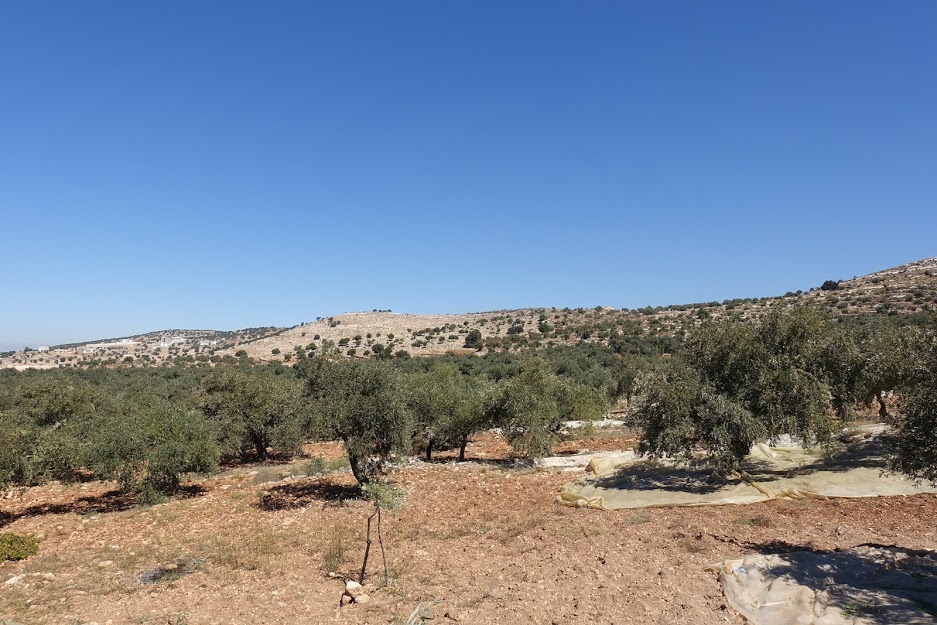
The olive tree orchard in Ajloun
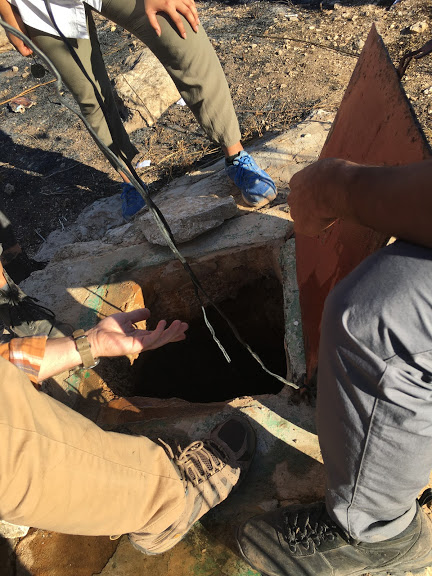
This orchard has a well that was dug by the Romans on the property. It still gives fresh water!

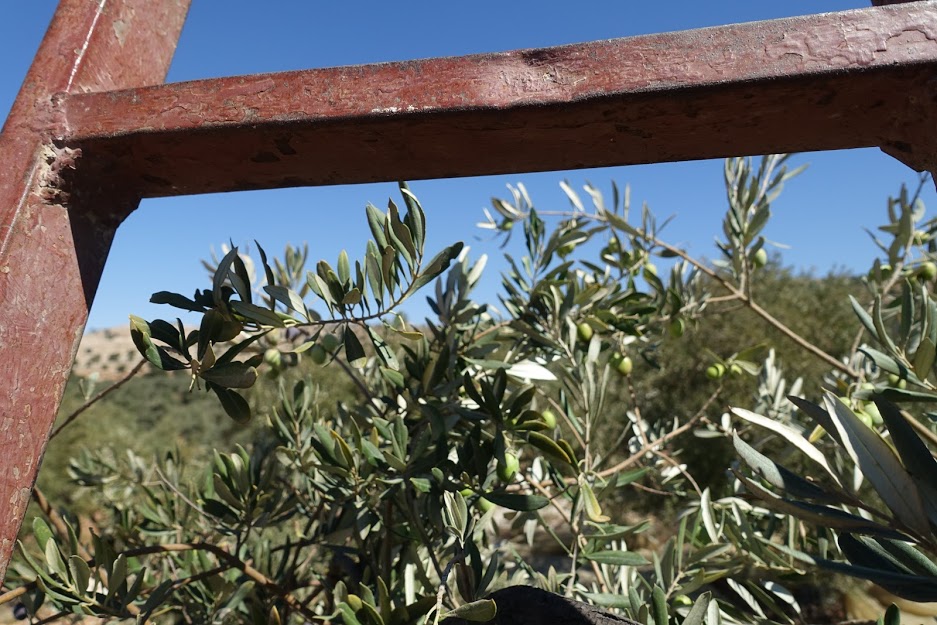
Olive picking in Jordan is not easy work. It’s long hours in the sun day after day, but if you have friends with you, the time passes quite quickly. We are also told that not a single olive is to be left on the tree, it must be picked clean! While olive trees are not tremendously tall, you still need a ladder to get the olives at the top, but if you don’t have a ladder, there are other ways to acquire the harvest..

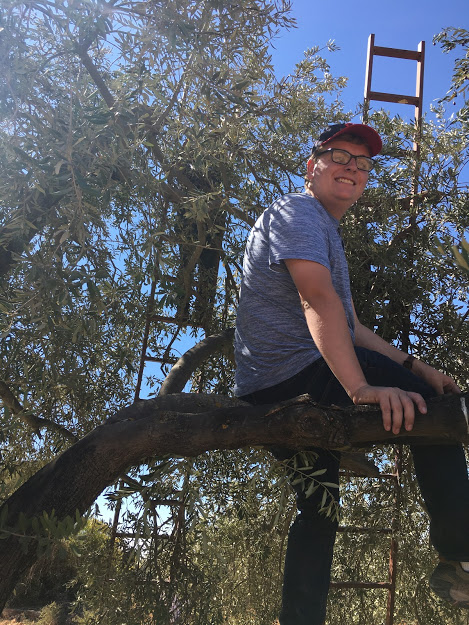
Climbing the tree just feels a lot better than using the ladder
Eventually, I had to use the ladder to get the olives at the very top of the tree

One of the center coordinators at CIEE grew up and still has family in Ajloun, so when we were done harvesting, we enjoyed a dinner with them in the orchard.

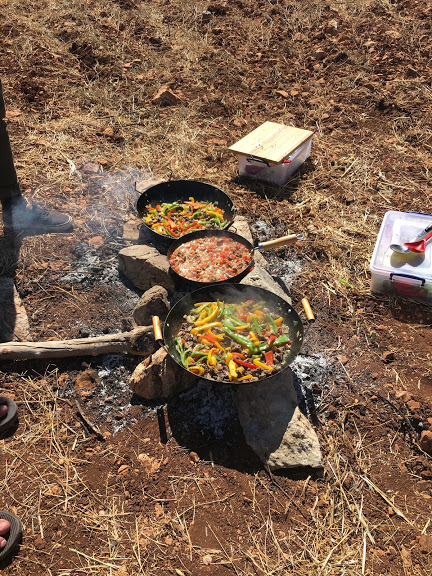
Cooking over a fire in the middle of the orchard
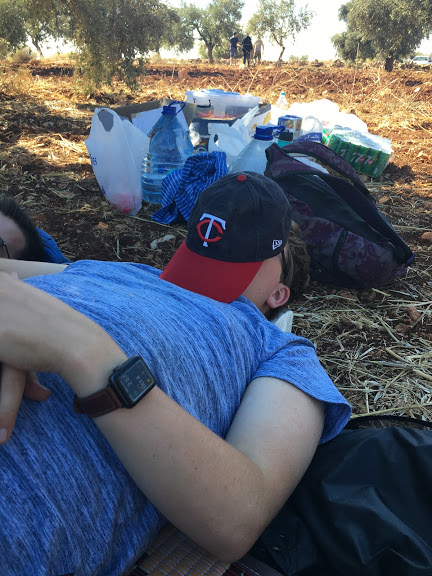
My friend got this photo of me while we were waiting for dinner to finish; Olive picking is hard work! (Also, thanks for the hat Ben).
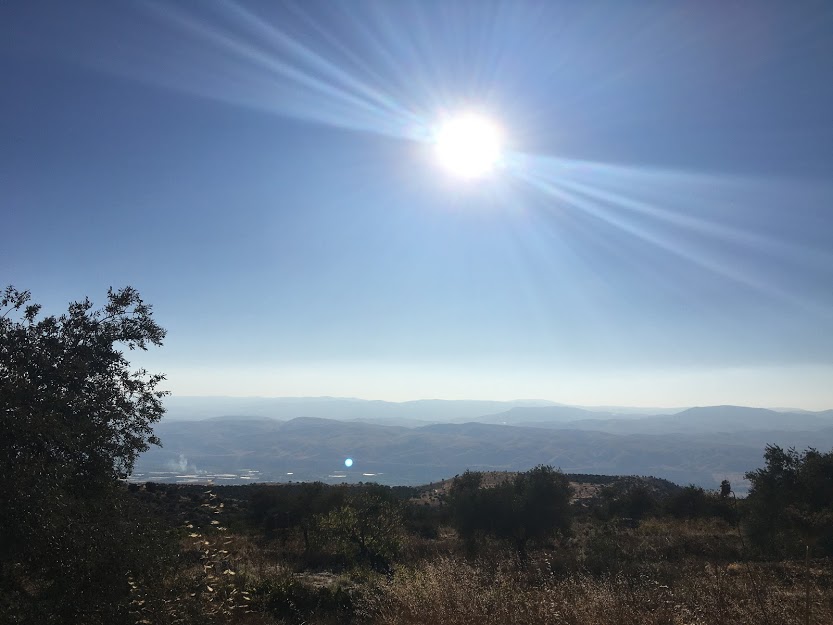
From the edge of the orchard, you can see as far as Israel-Palestine on a clear day like this one

After returning home, I quickly fell asleep and did not wake up until 11 AM the next morning.
Midterms commence tomorrow morning so today was mostly filled with study. While doing Arabic drills on my patio, I heard a noise like stones bouncing off of metal. I looked out to the street and it was raining! The first rain of the season was today, and it was fun to watch kids in my neighborhood run out to play in it like how kids in the US play in the snow. The rain only lasted about 20 minutes, but it still seemed to be a momentous occasion for the kids of Ahmad bin Hanbal Street.
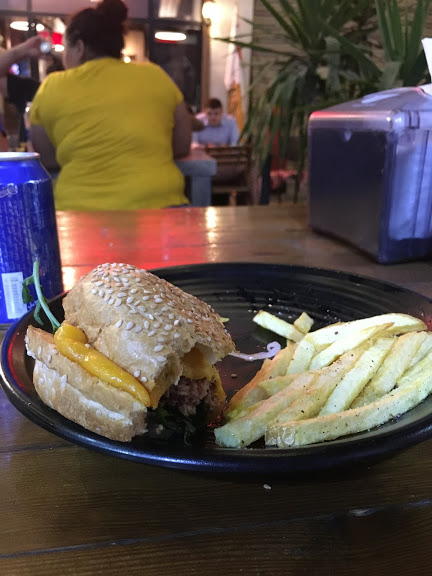
In the evening, after mass, I decided to indulge a little bit and go to Fatty Dab’s Burger Shack, which supposedly has the best burgers in Amman. I even sprung for the milkshake to make it a true American meal.

I lasted a month and (almost) a half without having American food, I deserved this
Beyond a pretty great burger, I found a section of Amman with a diverse assortment of restaurants and coffee places. I can’t wait to come back here.

Following midterms, I’ll be on fall break from October 10th to the 19th. My friends and I have an amazing itinerary planned, but, once again, you’ll have to wait until next time to find out what’s on it!

-Matt

Another Weekend in Amman

September 29th, 2019 – Finally, after almost of month of weekend adventures, I spent a weekend in Amman. It was a pretty lazy weekend, filled with homework before midterms and catching up on sleep. However, my friends and I still manged to visit 2 really cool sites in Amman: the Jordan Museum and the King Abdullah I Mosque.

The Jordan Museum is a fairly new museum in Amman, opening just 5 years ago. The museum holds quite the collection of artifacts from Jordan’s history between 7500 BCE and the Byzantine Era. The oldest artifact in the museum is the “Two Headed Statue” and other plaster statues found near Amman in the 1980s. Archaeologists and anthropologists do not know much about their purpose or the people who made them, but they claim the statues are one of the oldest in the world.

The statue dates back to 7500 BCE! That means those eyes have been staring into people’s souls for millennia!
Another statue found with the Two Headed Statue
A third statue from the same site

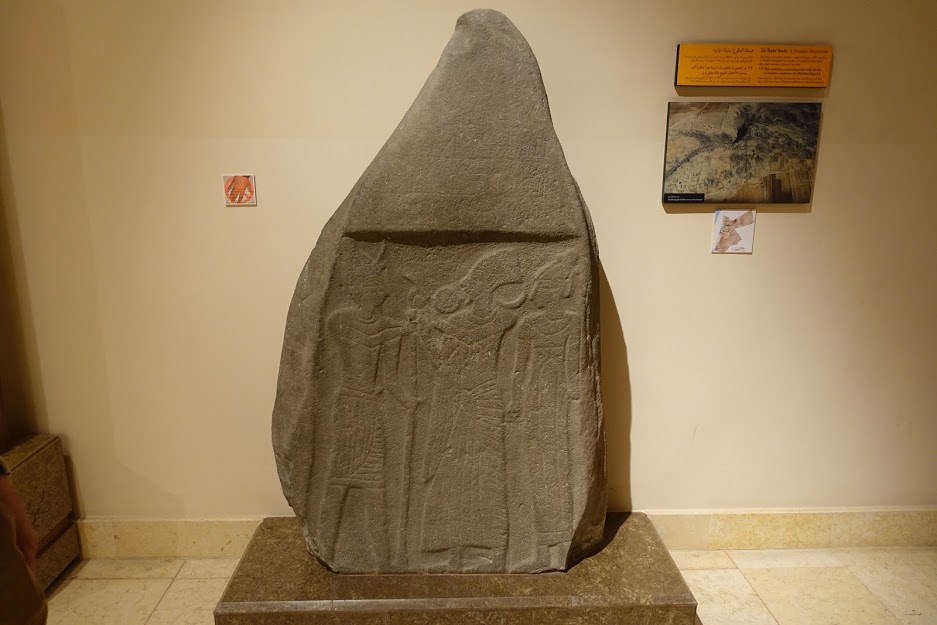
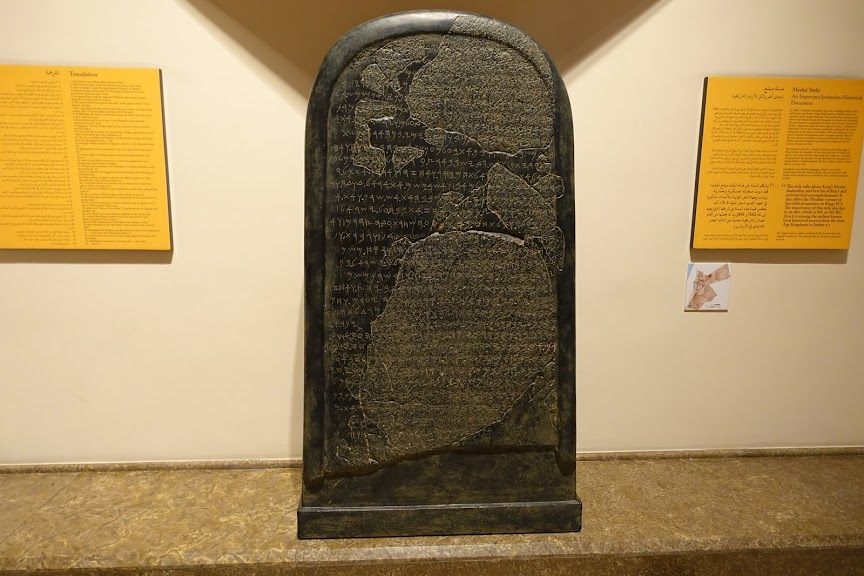
The museum then moves into a section on the Bronze Age in Jordan. This exhibit includes many objects found near the city of Karak, about 90 miles south of Amman. Many of these objects are of Moabite origin. The Moabites were the ancient kingdom that controlled most of present-day central Jordan during the late Bronze and Iron Ages. The Moabites are often referenced in the Old Testament, mostly because of their clashes with the Israelites and their juxtaposition with two other tribes: the Edomites (Southern Jordan) and the Ammonites (Northern Jordan). The two most significant items in this exhibit are two Steles: the Al-Balu’ Stele and the Mesha Stele.

The Al-Balu’ Stele’s writing is illegible, but the depiction of the art shows the influence of Egyptian culture over the ancient Near East during the Iron Age
A replica of the Mesha Stele. The Mesha Stele tells about the many victories of King Mesha of Moab over many peoples, including a kingdom called “Israel”. The story on the stone parallels the story in 2 Kings 3.

Unfortunately, the original Mesha Stele is on display at the Louvre in France. Jordan has demanded the stone be returned, but France has yet to comply with this demand (*sigh*). However, it was still really exciting to see a replica of the Stele. Last fall in Dr. Bucher’s Hebrew Bible and the Ancient Near East, we talked about the significance of the Stele as an extra-biblical source of the 2 Kings 3 narrative. It still makes my heart skip a beat to see the lessons I’ve learned at Etown come to life in Jordan.

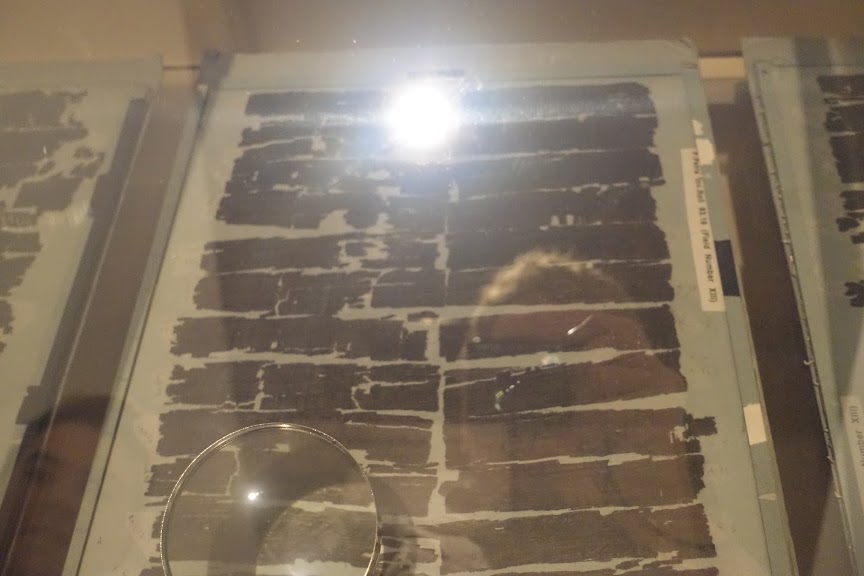
The rest of the museum focuses on Jordan during the Classical Era, which includes Greek and Roman statues recovered from all over the country, the Petra Papyri, and the copper Dead Sea Scrolls.

A Greek-era statue found near Petra
The Petra Papyri, which has to be viewed through a light-sensitive case. The Petra Papyri describes the life of the family of Theodoros, the deacon at the Petra church. The documents describe events in his family including weddings, land purchases, tax collections, etc.
A picture I secretly snapped of the original jars that contained the Dead Sea Scrolls

Recently, I was also able to tour the King Abdullah I Mosque. The Mosque was built to memorialize the late King Abdullah I, the first king of the modern state of Jordan, by his grandson, King Hussein I. The story of King Abdullah I is tragic. While praying with his grandson, Prince Hussein, one Friday in 1951 at the Al-Aqsa Mosque in Jerusalem, King Abdullah I was assassinated by a Palestinian who believed rumors that he and the Prime Minister of Lebanon (who was assassinated in Amman 4 days earlier) were negotiating a joint separate peace deal with Israel. The assassin attempted to kill Prince Hussein, but he was saved when the bullet was deflected by the medal King Abdullah I insisted he wear on his chest.

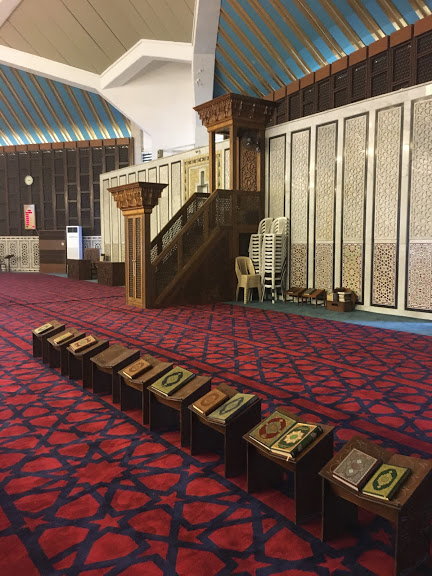
The Mosque is one of the largest in Jordan. It can hold 3000 worshipers beneath its beautiful blue mosaic dome. It’s also one of the few mosques in Jordan that tourists are allowed to visit.

The view from the Mosque’s courtyard
The front of the male prayer area
A Panorama of the Male Prayer area
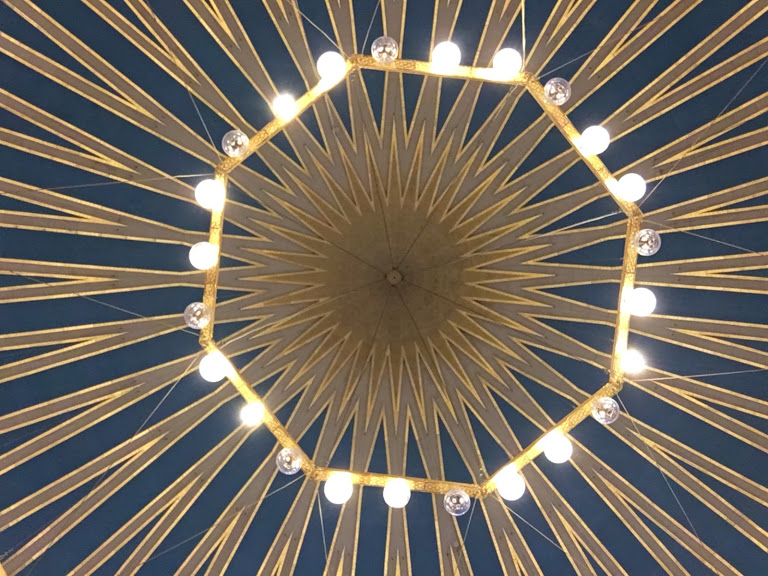
The interior of the Mosque’s great dome

It was a relaxing break from traveling this weekend. I spent lots of time on the patio connected to my bedroom doing homework or writing. The nights are starting to get cool here in Amman. Currently, I’m sitting on my patio in a long-sleeve shirt because the breeze adds an unexpected, but welcome, chill to the air. I will be traveling a bit this weekend, but you’ll have to wait until next time to know where I went!

-Matt

Wadi Rum and Petra

“What does the desert have to whisper to your soul?”

September 22, 2019 – I had the most amazing experience of my young life this past weekend. Through CIEE, several of us were able to explore and camp overnight in Wadi Rum and go to Petra the following day. Here’s how the weekend went:

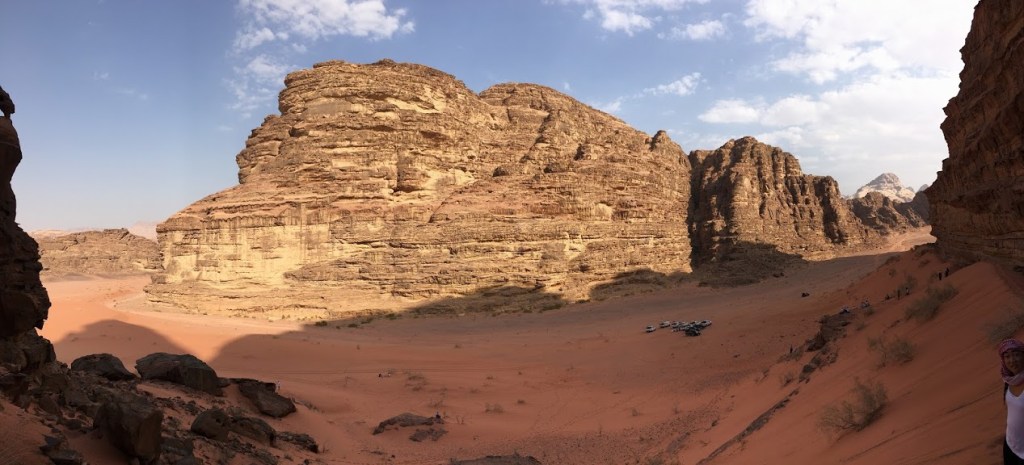
We arrived in Wadi Rum after driving south from Amman on the desert highway for about 5 hours. Wadi Rum, also called the Valley of the Moon, is most famously known in the West because of T. E. Lawrence’s book Seven Pillars of Wisdom about his time in Wadi Rum, and the film Lawrence of Arabia, which was filmed in Wadi Rum. After we got settled in at camp and a quick lunch, we loaded into the back of pickup trucks for a tour of the desert.

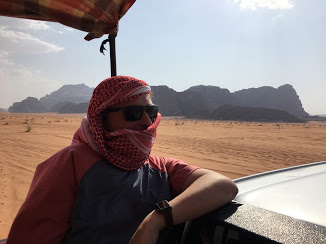
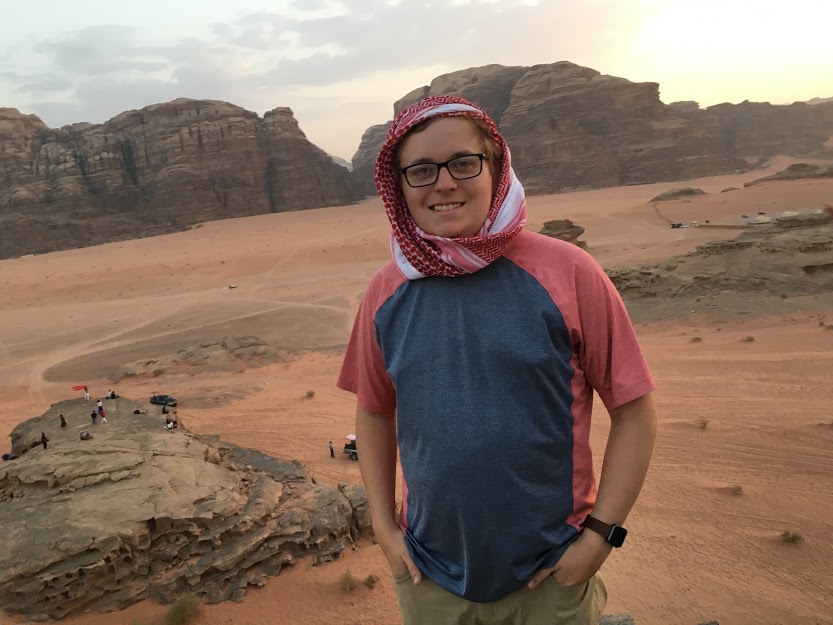
Me at the start of our tour. We were given the keffiyehs at camp, which were extremely functional in the desert.

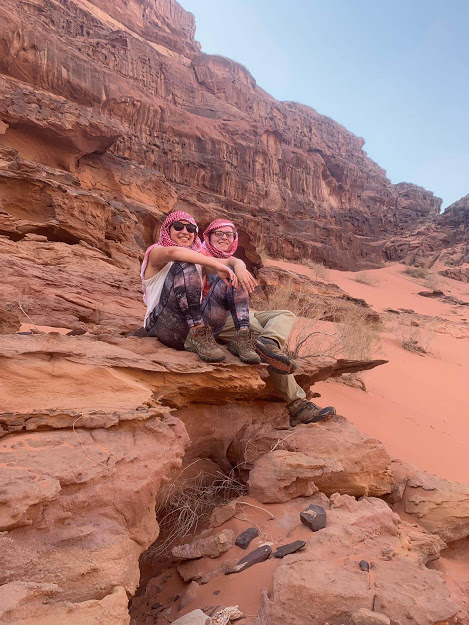
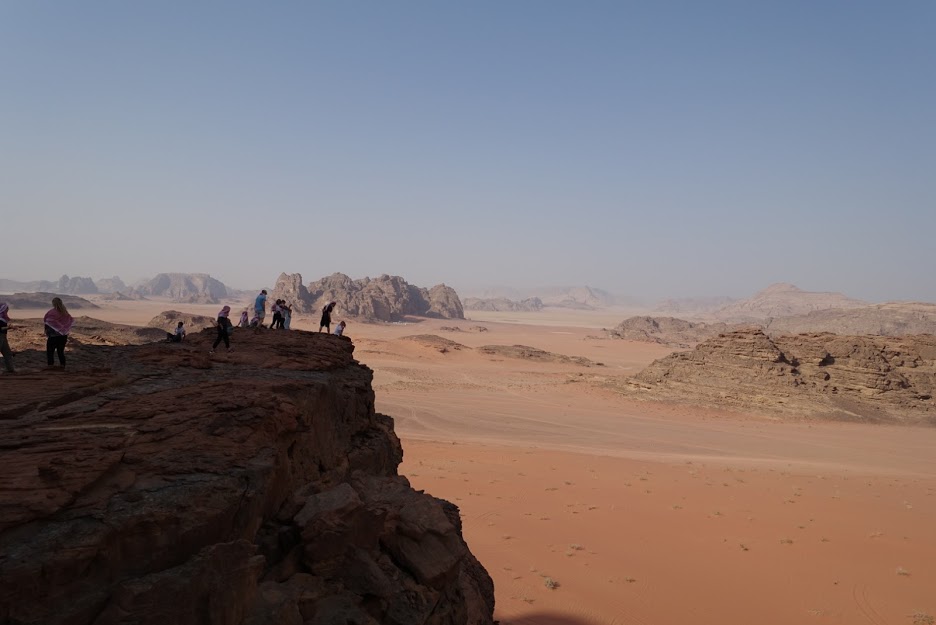
Our first stop was a large sand dune that led up to a small rock formation. Being young and adventurous, my friends and I decided we had to climb the dune and reach the top of the cliff. We quickly realized that attempting to run up sand dunes is the best cardio workout in the world, as we stumbled over and over while the sand provided no traction. When we reached the overlook, we were relieved for a few minutes of rest before we had to run back down the dune.

Halfway up the dune
The view from the top of the dune
Another shot of the cliff

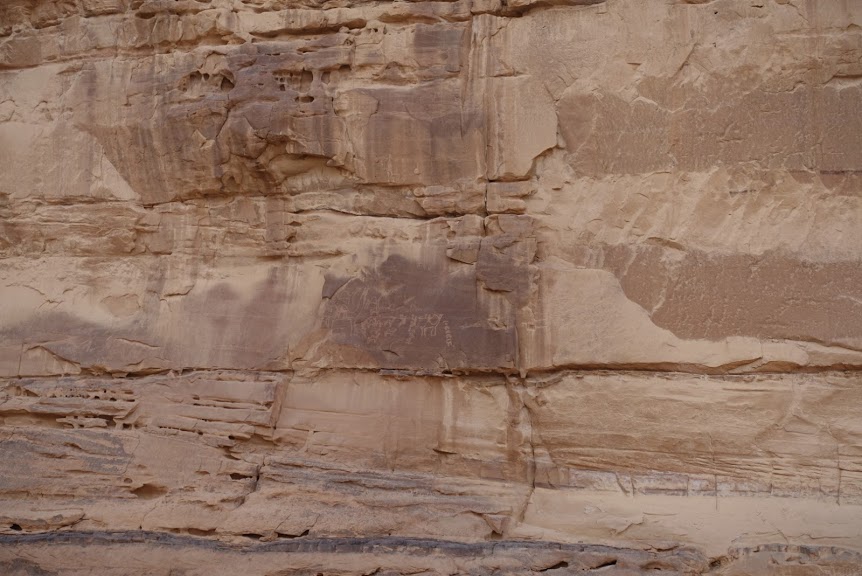
After this we loaded back into the trucks to see something truly amazing. High up on a cliff, archaeologists uncovered inscriptions from approximately 3000 years ago. Desert caravans used to inscribe on the soft sandstone as a means of leaving messages for other caravans.

If you look closely at the center, you can see a drawing of a caravan of camels with other tribal symbols

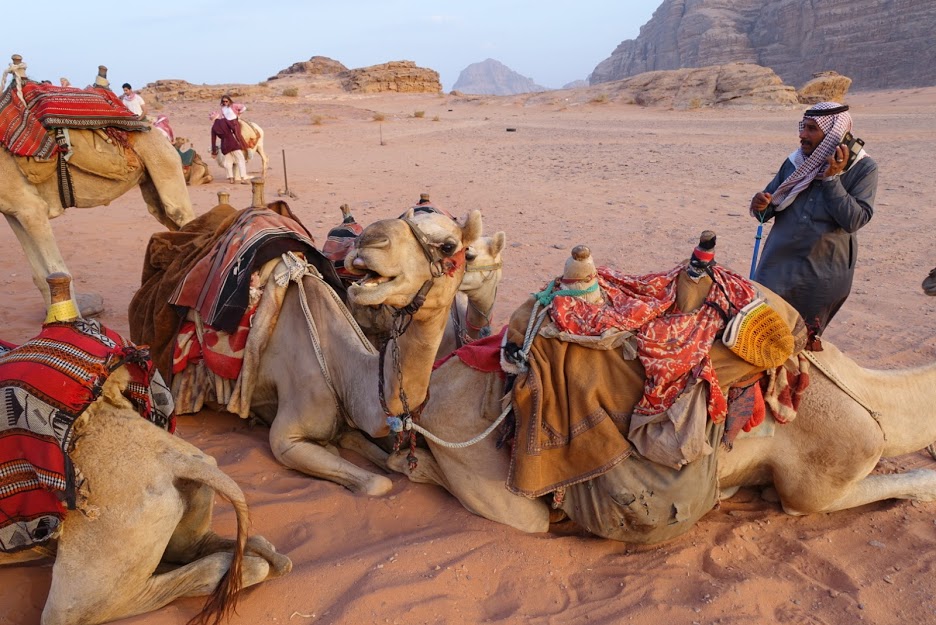
After one last ride in the trucks, we found ourselves taking a new form of transportation: the ship of the desert.

These camels were our trusty steeds for about 25 km on our way to the sunset point

I’m going to be absolutely honest. Riding a camel is very cool, but not very comfortable. Camels do not provide a smooth ride like horses, they bob up and down because of their odd gait. It makes for a sore core and lower back the next day. After we disembarked, we climbed up a small rock formation to sunset point. Watching the sunset in Wadi Rum was probably one of the most breathtaking experiences of my life.

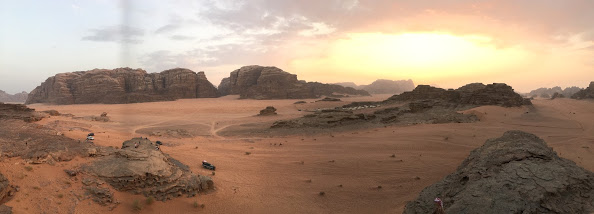
The sunset over Wadi Rum
(I fully plan on getting this photo framed)

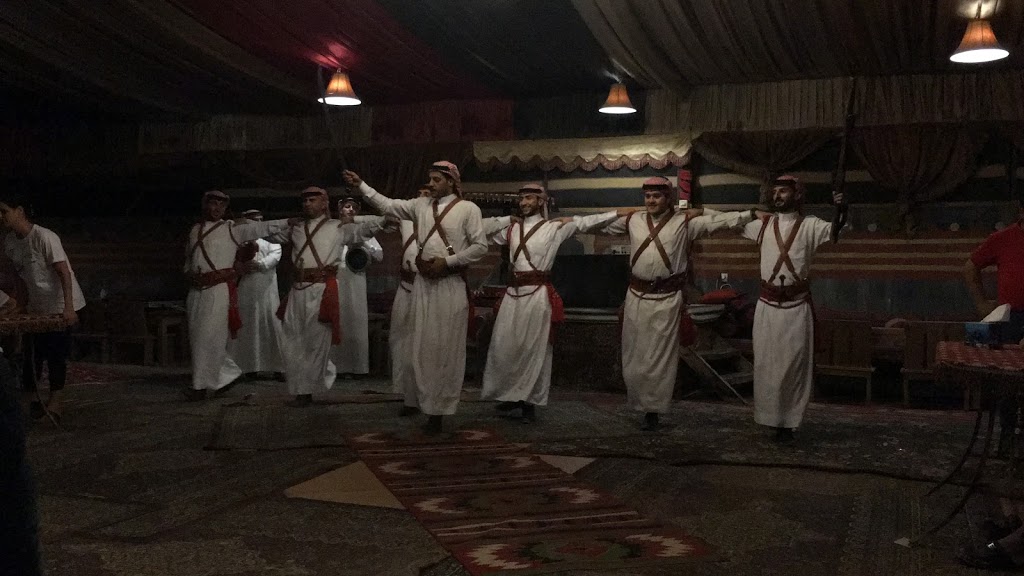
When we returned to camp, we quickly learned that going to bed early would not be an option. Our CIEE Center Coordinator loves to dance, and made it clear that we would also love to dance. So we all danced dabke for the better part of three hours with a group of professionals. It was honestly a lot of fun, and, another amazing cardio workout.

The dabke dancers

After dancing was over, we stayed up by the fire for a few more hours, and then, one by one, we all began to retire to our tents.
The next morning we woke up quite early to go to Petra, the Rose City. Petra was also famously featured in the West in the film Indiana Jones and the Last Crusade. Petra has also been inhabited since prehistory, but its great stone carvings were made by the Nabataeans, an Arabian tribe who settled there. Petra is hidden in the mountains, it cannot be seen until one passes through the rock cut that leads to the Treasury. This was the largest asset to Petra’s security, as its location puzzled the Greeks and Romans alike. After the Crusades, the city was thought to be lost, until its rediscovery in the 19th century.

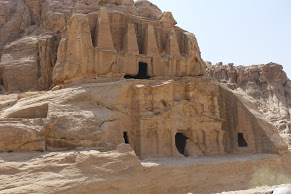
One of the tombs at the entrance to Petra
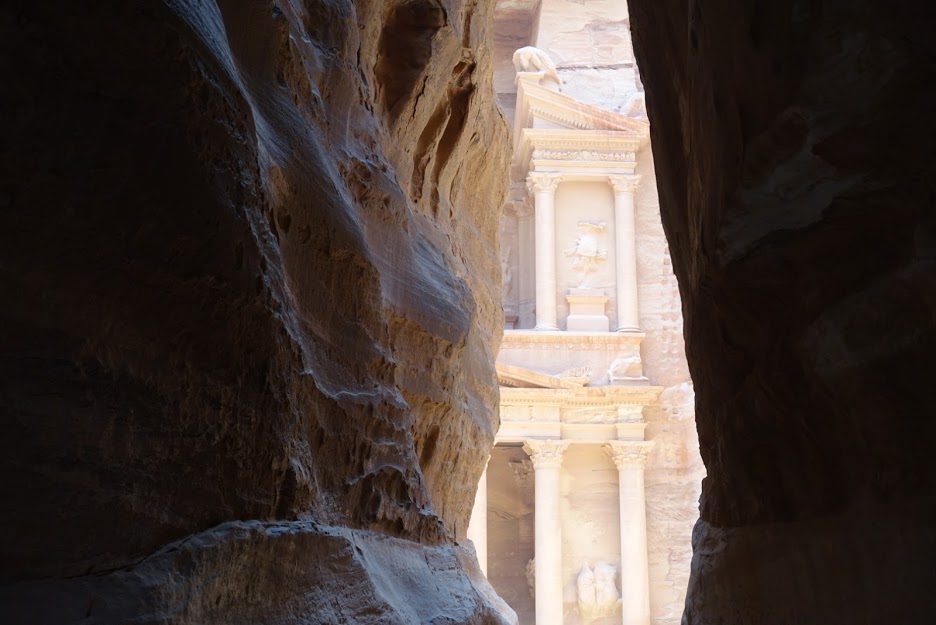
Definitely best photo from the entire trip; the Treasury as you approach from the rock cut
(I also fully plan on framing this photo)
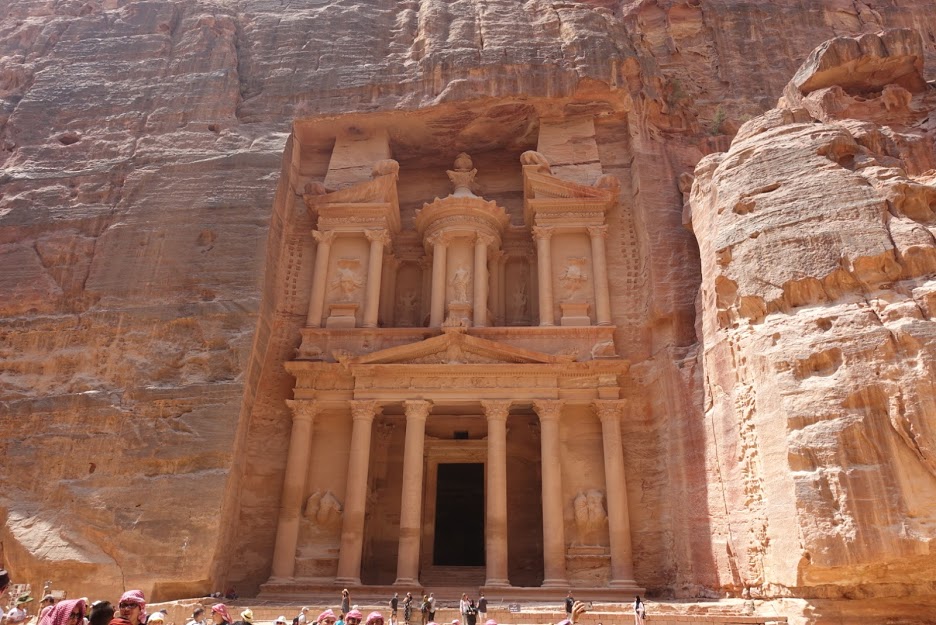
The famous treasury of Petra
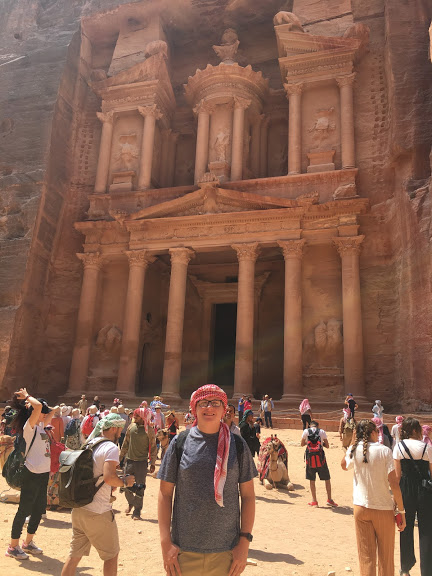
A quick size comparison
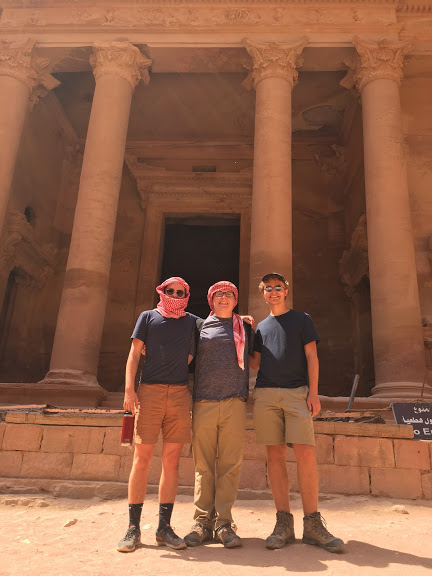
Chris, myself, and Ben in front of the treasury

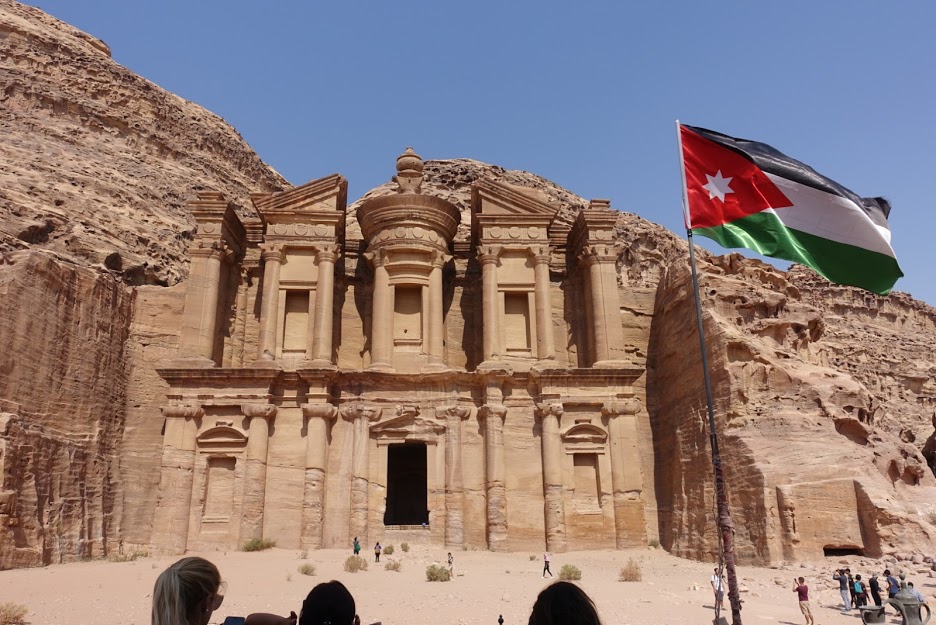
However, the treasury is not the largest structure at Petra. To see that, its a hike up 950 stairs in direct sunlight to the Monastery. Again, feeling young and adventurous, my friends and I committed to the challenge. This was also another amazing workout. I think I doubled my Apple Watch’s daily exercise goal at Petra and Wadi Rum. But I (eventually) reached the top, covered in sweat, to see Petra’s Monastery in all its glory.

Petra’s colossal Monastery

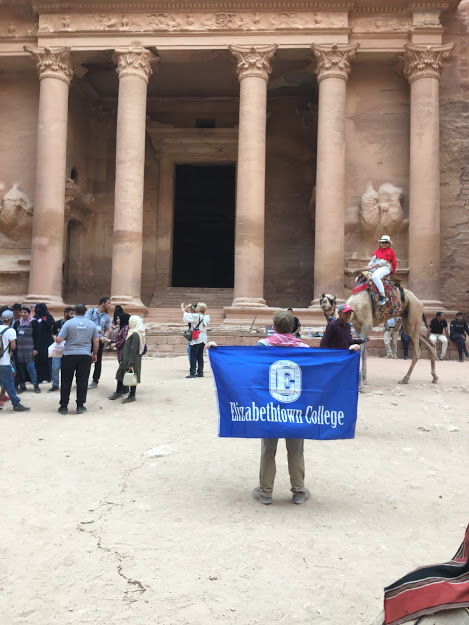
Finally, we started to head back to the bus. But not before I got my signature photo.

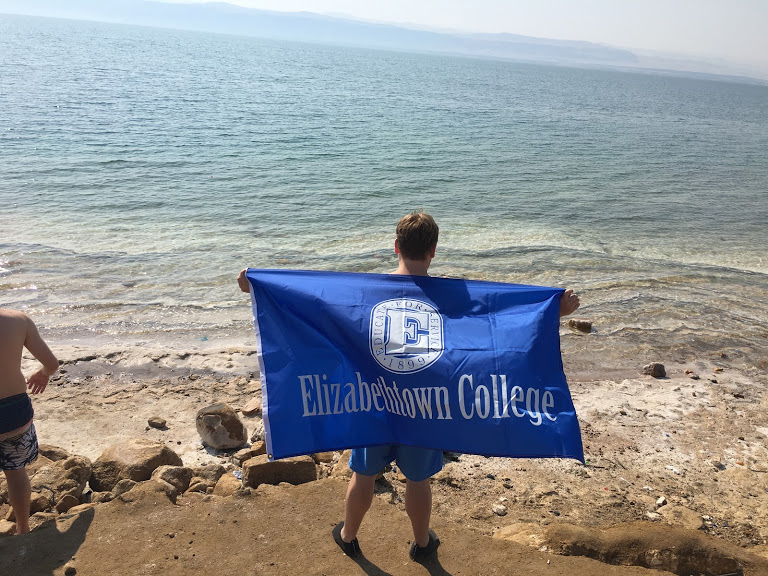
Did I really go anywhere if I didn’t get a photo with the E-Town flag??

The long bus ride home was filled with sleep and listening to The Lumineers’ new album (which is really really good). Now I’m back in Amman, resuming my normal routine of classes and cafe-hopping.

The desert whispered a message to my soul, and, maybe one day, I’ll fully understand what it said.

– Matt

The European Film Festival and Umm Qais

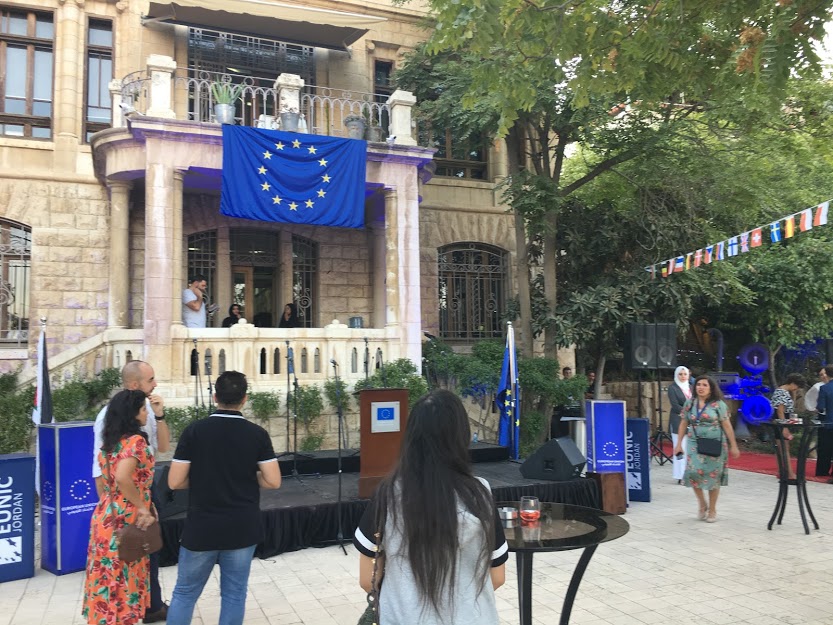
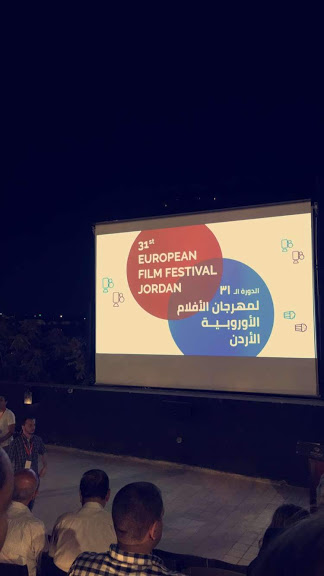
September 14th, 2019 – Another amazing weekend in the Hashemite Kingdom of Jordan! My friends and I started off the weekend by attending the opening ceremonies for the 31st European Union Film Festival in Amman. This year’s festival included films from 21 European Union member states and 1 film from Turkey (which was immensely interesting politically, but I won’t bore you with those details). The EUFF is made possible through the patronage of Her Royal Highness Princess Rym Ali (who attended the opening ceremonies). The opening ceremonies were elegant to say the least. I felt quite under-dressed in my khakis and and shirt standing in the same courtyard as EU member state ambassadors to Jordan in their suits and ties. The EUFF runs through this weekend and I hope to attend some of the films!

We got there pretty early, by nightfall it was hard to move in this courtyard
The screen was set up in an old amphitheater overlooking the city

We stuck around for the first film, then the staff told us about the after-party near my homestay, so we went there for awhile before heading home. The next day I was up quite early for a weekend to meet up with my friends Sarah, Chris, Jack, and Ben to head all the way up north to Umm Qais. Umm Qais is an ancient city (then called Gadara) that was a member of the Decapolis (“Ten Cities”). Of the 10 cities, 8 of them reside in Jordan, 1 in Israel-Palestine (Bet She’an), and 1 in Syria (Damascus).
Fun fact for all my readers back home: Under the Greeks, Amman (also part of the Decapolis) was called Philadelphia!

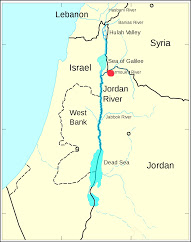
A map I edited for reference. The red dot is the approximate location of Umm Qais.

Umm Qais has several thousand years of history in its ruins including the Greeks, Romans, and Byzantines. Following the Umayyad conquest of the area, an earthquake destroyed the town, leaving it mostly uninhabited. The city’s unfortunate history doesn’t stop there. With its close location to the border with Israel-Palestine, Umm Qais was bombed heavily during the Six-Day War in 1967. Our guide, a former resident of Umm Qais, informed us that some people still lived in the old Roman homes until the late twentieth-century when the Jordanian government relocated them to make the place a historical site.
**Side note: Umm Qais (Gadara) is an important location for biblical scholars, as the Gospels of Matthew, Mark, and Luke mention Jesus exorcising a demon in this region, but cite it in different cities: Matthew in Gadara, and Luke and Mark in Gerasa, a city closer to Amman. (See Mark 5:1-20, Matthew 8:28-34, and Luke 8:26-39, if interested).**

The old homes of Umm Qais
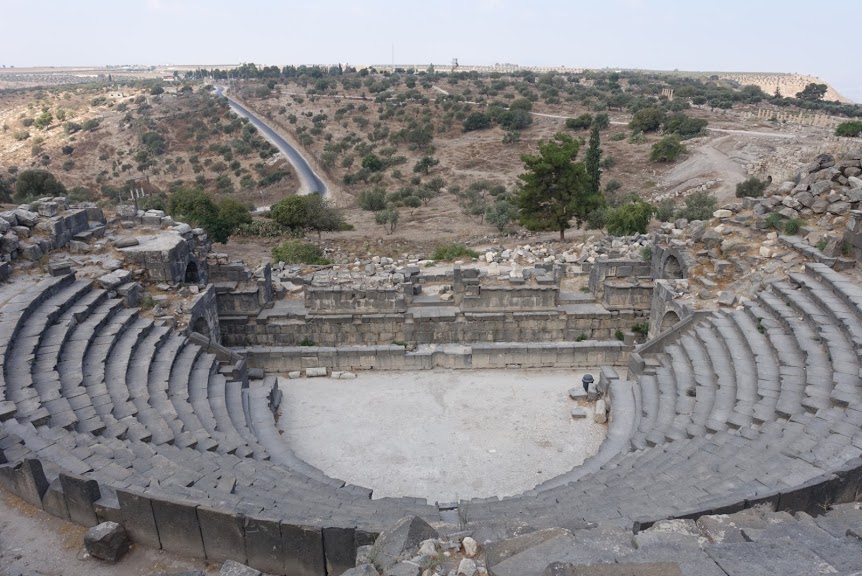
The Amphitheater (made of Basalt stone, unlike the one in Amman that is made of Limestone)
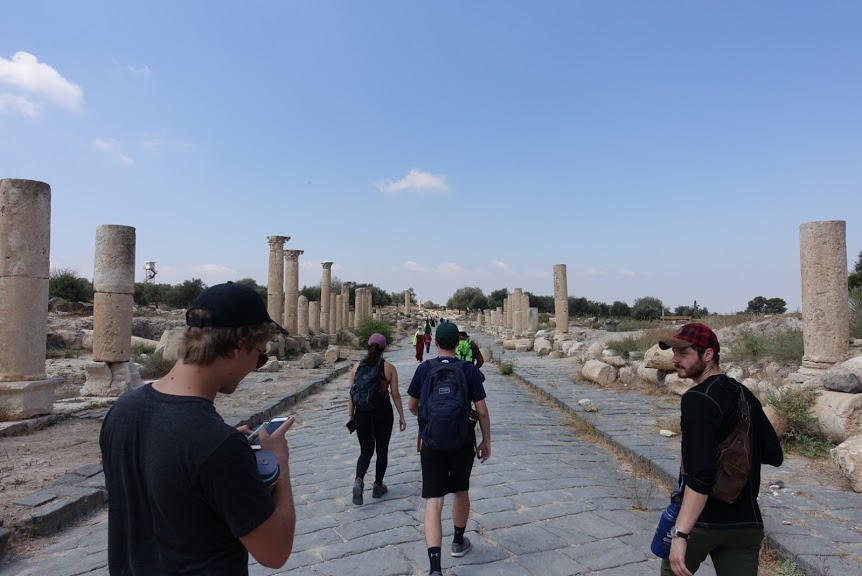
My friends on the Roman road that leads from Umm Qais to the fields of olive trees

After seeing the city, our guide led us on the eco-hike to the overlook point. To get to the overlook, we hiked for about 2 and a half hours through groves of olive trees, high grass, and grazing fields.

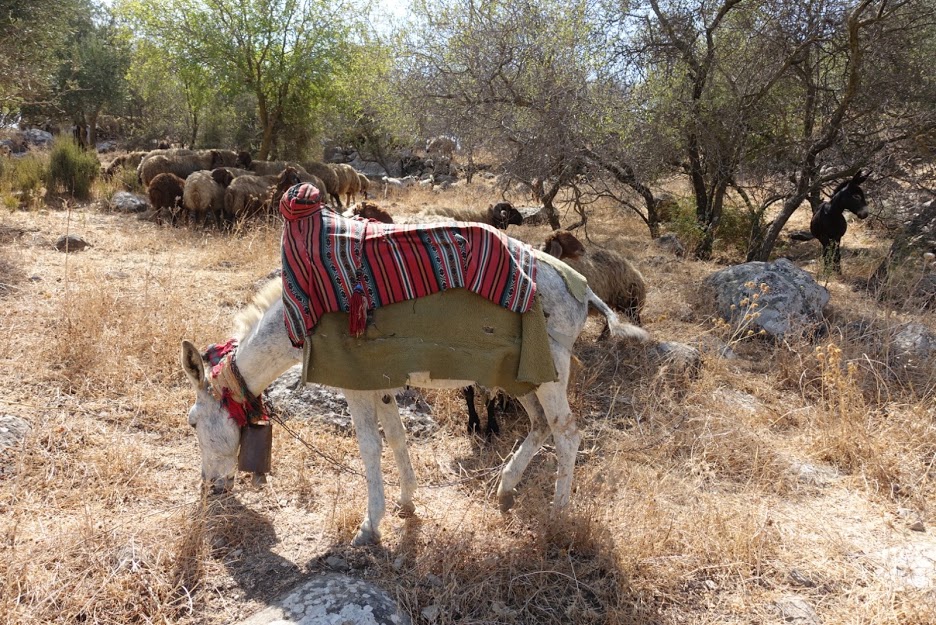
Along the way, we passed a local farmer with his flock

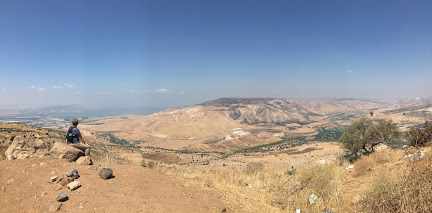
Once I reached the overlook, the 2 1/2 hour hike in 90 degree heat was worth it. The mountain overlooks the Jordan Valley, from the Sea of Galilee, across the Golan Heights, and (on clear days in February) all the way Mount Hermon in Lebanon. At the overlook, we were only about 3 kilometers from the Syrian and Israeli border.

This is my favorite picture of the day. There are 3 countries in this photo: Jordan, Israel-Palestine, and Syria!
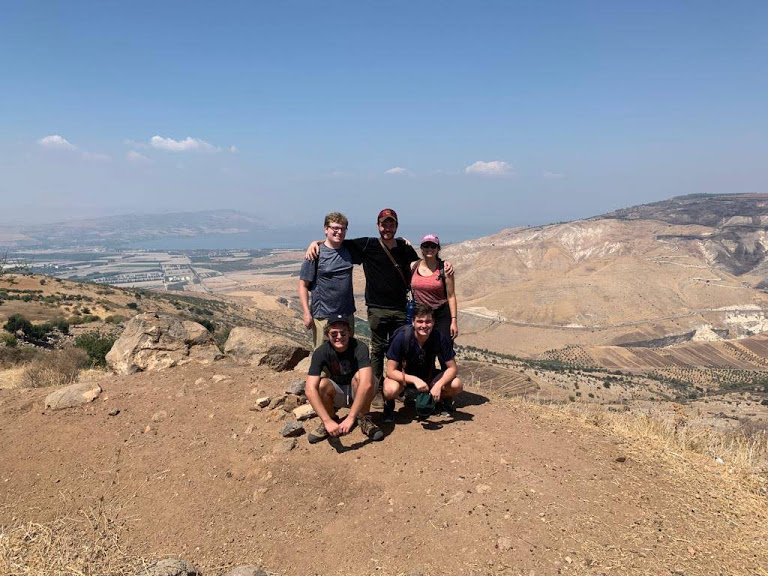
From left to right: Me, Jack (Penn State), Sarah (Georgetown), Ben (University of Puget Sound), and Chris (Brown University)

After the hike we enjoyed a lovely lunch and re-hydrated with lots of water. When I got home that night, I nearly fell asleep in the clothing I was wearing.
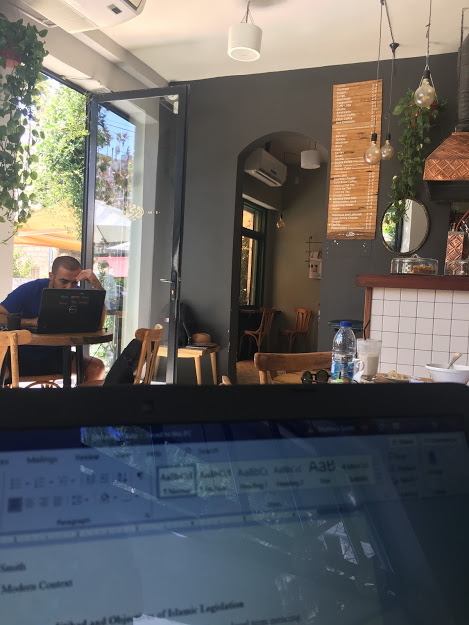
Another good part about the weekend in the Arab world is that it’s totally socially acceptable to sleep until 11 AM (I now expect this to acceptable at home too, mom). I spent today in my favorite cafe, Rumi Cafe in Weibdeh, doing my Arabic and Islam homework. Rumi has a wide selection of teas from all over the region: Morocco, Iraq, Yemen, Bahrain, and, my favorite, Iran. Iranian tea is a caffeinated tea with an earthy taste and requires no sugar, so it’s perfect with a slice of carrot cake.

Yes I actually have to do homework sometimes, but Rumi makes it more tolerable

This weekend, CIEE will be taking us to Petra with an overnight stay with Bedouins in Wadi Rum! Stay tuned for more updates from Jordan!

-مات

P.S. – The above script is “Matt” in Arabic, but if you google translate it, it will translate as “Die”. This is because “Maat” means “he died” in Arabic.

Madaba and other Adventures

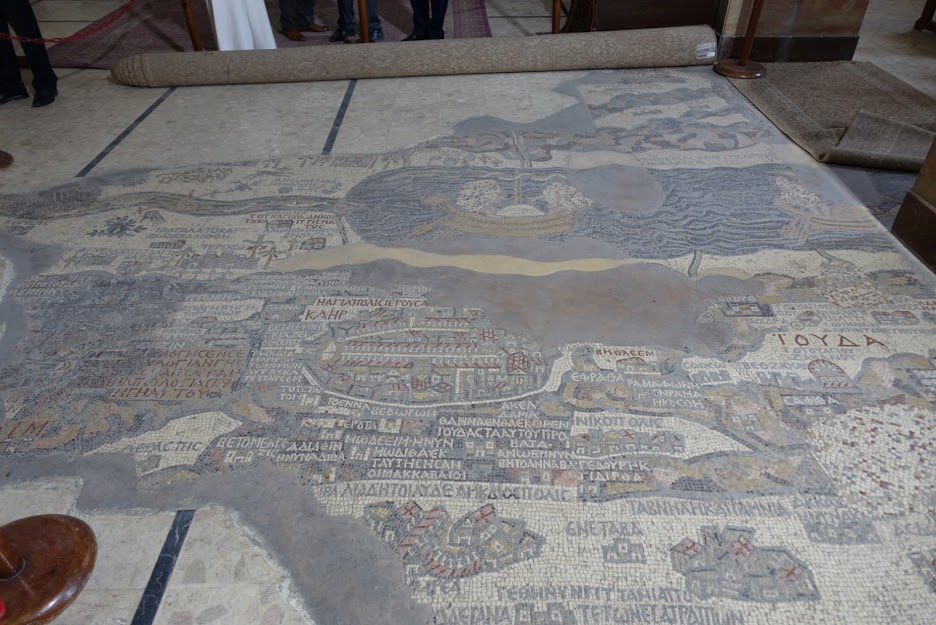
September 7, 2019 – This past weekend I traveled down South from Amman to the city of Madaba. Myself and five friends, Tess, Ben, Sarah, Chris, and Jack, left right after class on Thursday and caught a bus at the Northern Bus Station that would take us to Madaba. Once we arrived in the city, found our Airbnb, and got settled, we went off to see some of Madaba’s famous mosaics. Out of all the mosaics, one stands out among the rest: the Madaba Map. The map dates back to the 6th century CE, when pilgrims would use the mosaic to orient themselves while in the Holy Land. The map was thought to be lost, but was rediscovered when foundations were being dug for houses in Madaba. The map now sits in a Greek Orthodox Church for tourists from around the world to see.

The Madaba Map
The City in the center is Jerusalem and the body of water at the top is the Dead Sea

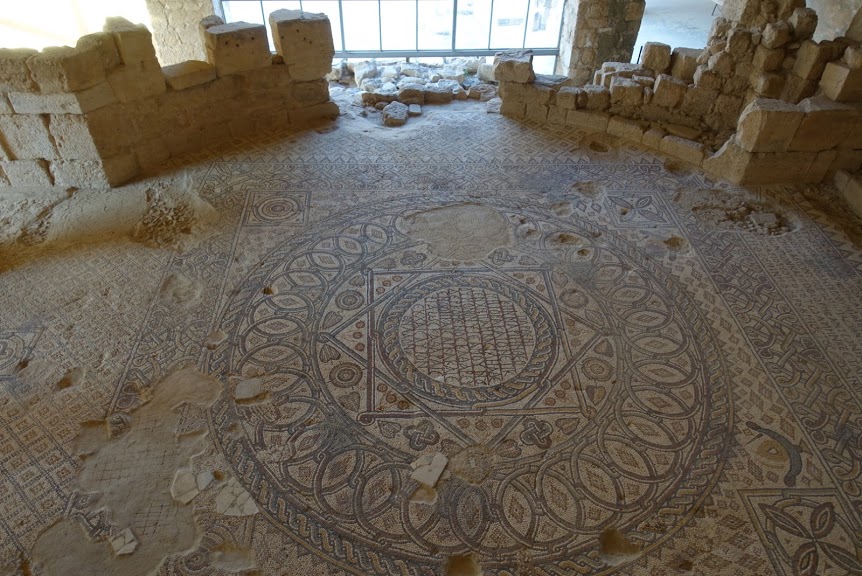
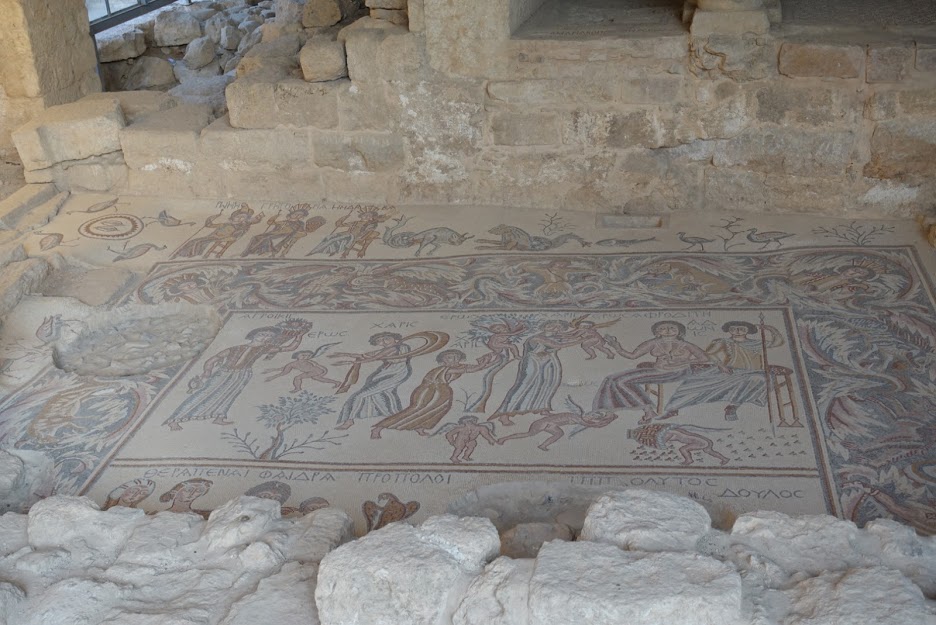
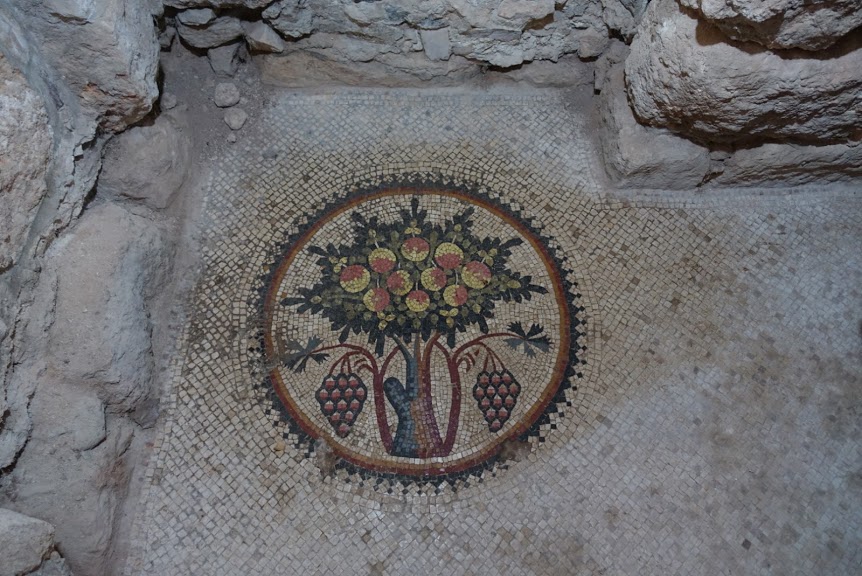
After we saw the map we went to the Madaba Archaeological Park, which has many more recovered mosaics, including part of the King’s Highway, the Church of the Virgin Mary, a Roman home, and the famous Tree of Life mosaic.

The Church of the Virgin Mary and its recovered mosaic
A mosaic from an old Roman home
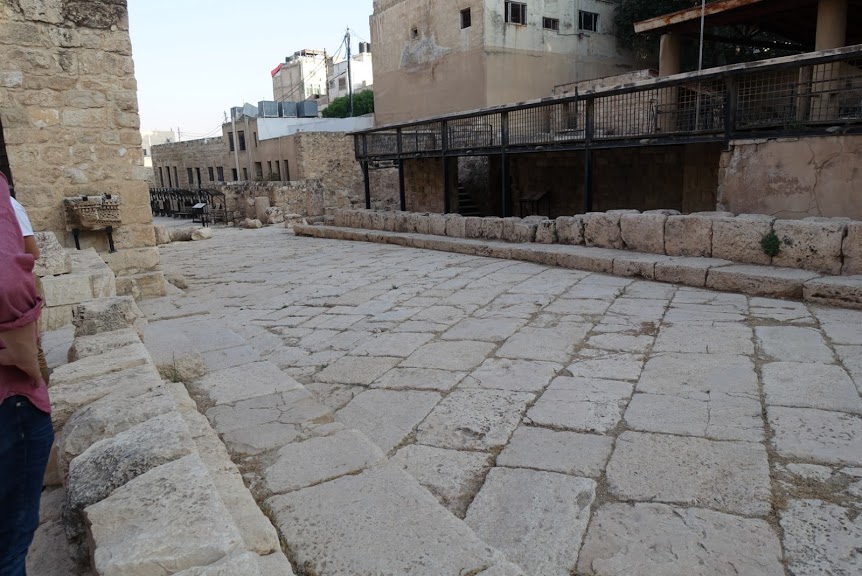
A Roman road that was part of the King’s Highway
The King’s Highway historically led from Heliopolis, Egypt to Resafa, Syria.
In Jordan in stretches from Aqaba on the Red Sea to Jerash, a city north of Amman
The famous Tree of Life mosaic.
The mosaic depicts the Tree of Life from the Garden of Eden as described in the Book of Genesis.

The next day we went to Wadi Mujib and the Dead Sea. Wadi Mujib is a hiking trail up a river near the Dead Sea. When I say “through a river”, I really mean it. This is not a relaxing hike along a babbling brook, Wadi Mujib is a large, mostly slow moving river through a canyon that leads to a waterfall. On the trail, I had to use ropes to cross deep waters and fast currents, climb up small waterfalls via ladders or rock formations, and swim against the current. The reward for my effort was a stunning waterfall and rocks that can be used to jump into the deeper waters (don’t worry mom, they made me wear a life jacket the entire time and the rocks weren’t that high). Then, to get back to the trail head, I was able to just float back down the river. Unfortunately, I don’t have any photos of the trail because of the water. I used my GoPro to record the hike and hopefully I will be able to upload some of that video soon.

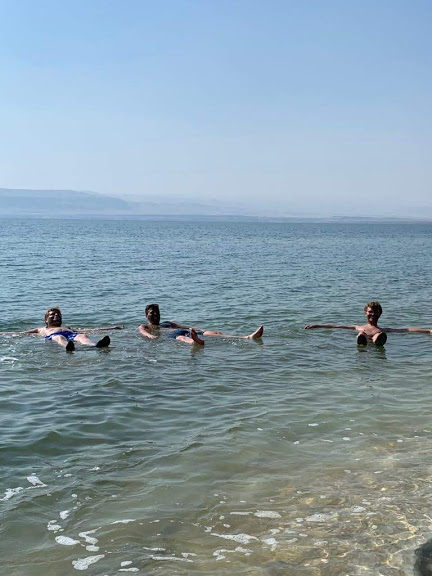
As a way to relax after Wadi Mujib, we all went to the Dead Sea. The last time I was at the Dead Sea was in Israel-Palestine in 2013, so I was excited to visit the Jordanian side of the sea. At the Dead Sea, you can literally pick up large pieces of salt from beneath the water. The Dead Sea mud is also supposedly full of minerals that are amazing for your skin. Despite the heat, it was still a relaxing afternoon at the beach.

Blue Jays are everywhere! Even at the lowest point on Earth!
The Dead Sea is better than any spa treatment you could pay for

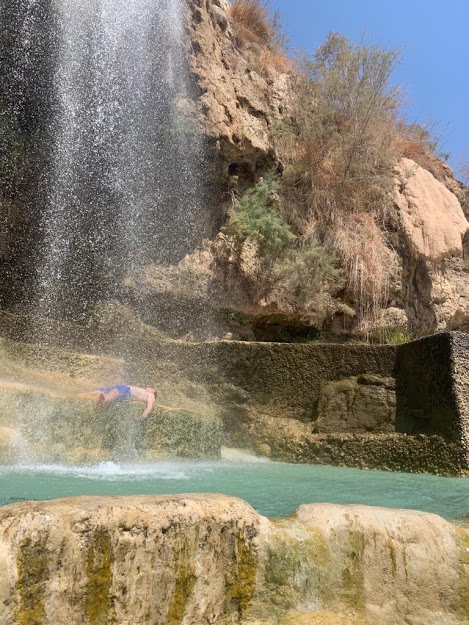
When we got back to the Airbnb I nearly collapsed into my bed I was so tired. The next day we got up bright and early to go to the Ma’in Hot Springs. These beautiful hot springs are located in the middle of the desert. These hot springs are HOT, reaching up to 65 Celsius (149 Fahrenheit) in September! Maybe it wasn’t the best choice on a hot day, but it was such an amazing experience we couldn’t pass up.

Ma’in was our real-life desert oasis after a weekend of exhaustion and dehydration

I’m currently sitting in my room in Amman. I returned to the city around 4:30 PM, went to mass, ate dinner at home, and now plan on going to sleep because I still have classes tomorrow! Thanks for reading!

-Matt
First Weekend in Amman

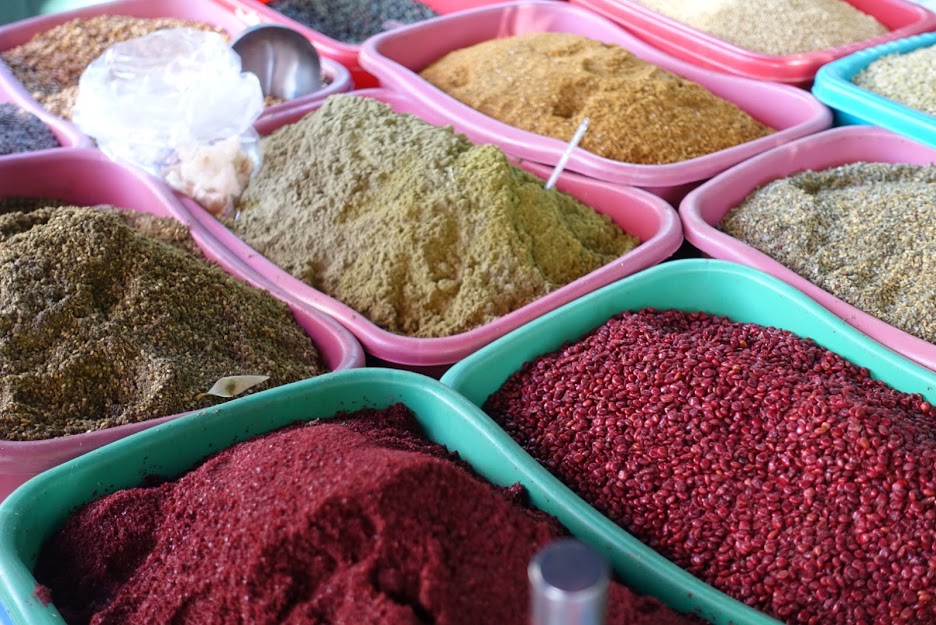
September 2, 2019 – The weekends in Amman are quite fun! This past weekend, my friends Tess, Chris, Sarah, and Ben, (other students with CIEE) and our other friend Omar (an American Fulbrighter doing research in Amman) went to the السوق الجمعة (“Friday Market”) on Rainbow Street. The سوق is full of different colors, aromas, tastes, and art from all over the region. One of the stands that sticks out in my memory was selling Armenian spices. The three women (a grandmother, her daughter, and her granddaughter) offered us samples f some of their spices. They were flavors I’ve never experiences before!! Also, the spices has such vibrant colors that I needed to take a photo of them.

Look at those colors!
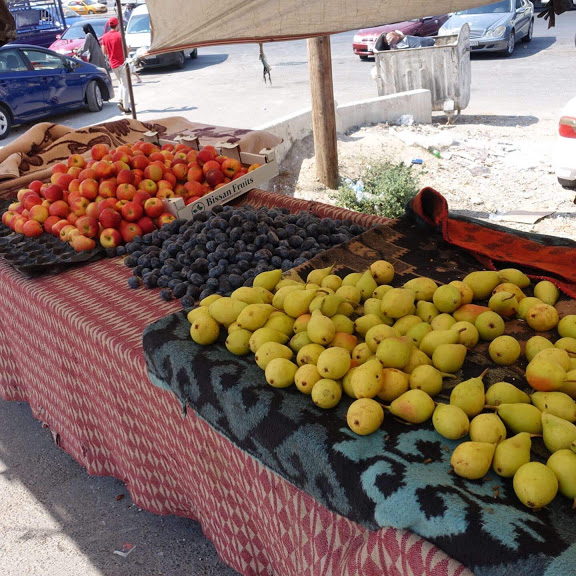
Fresh Fruit
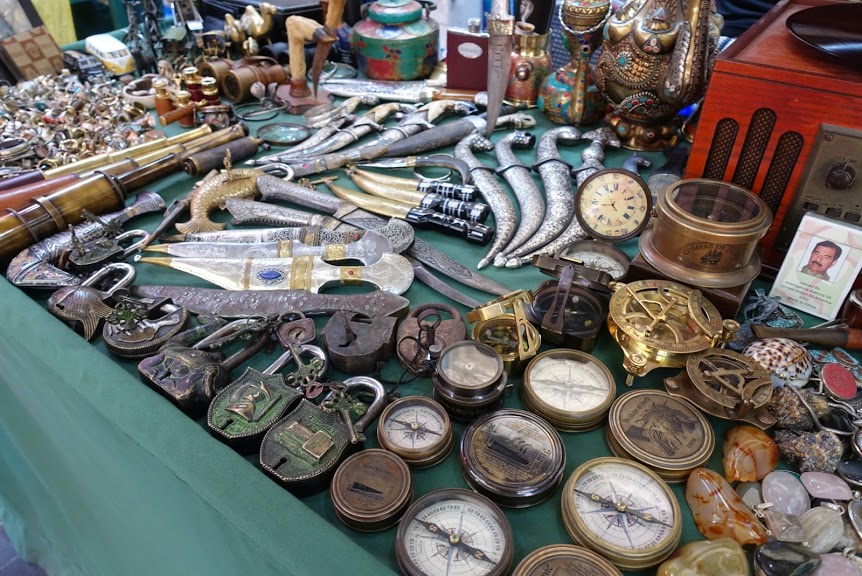
Lots of goods available at السوق

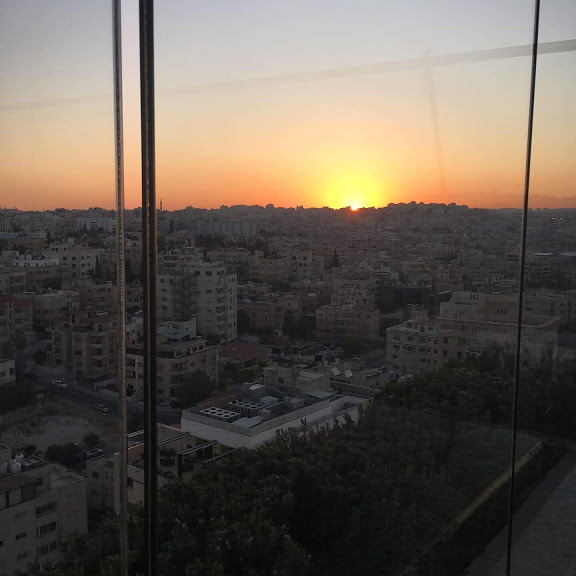
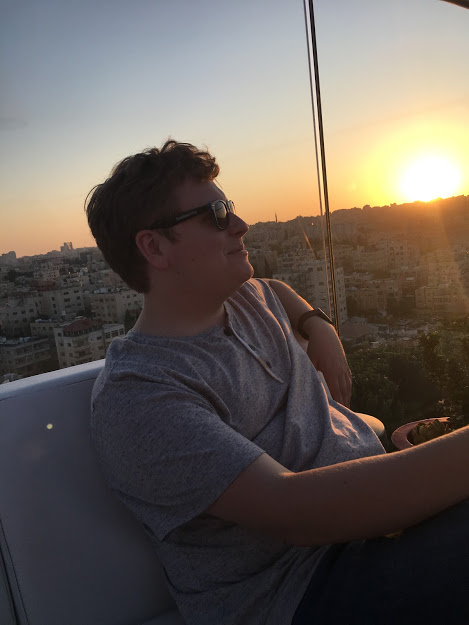
After a long afternoon at the market, we decided to head to a rooftop and watch the sunset. It was a great way to end our busy Friday.

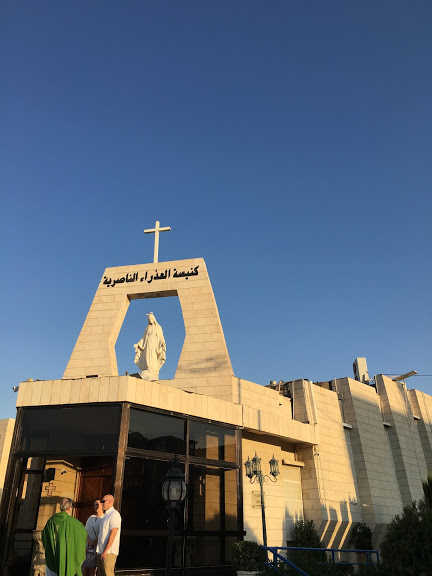
On Saturday, I went to an English speaking church run by the Jesuits. The Jesuits established a permanent mission in Amman in 1996 under the guidance of the Latin Patriarchate of Jerusalem (which oversees Catholic Churches in Jordan, Israel-Palestine, and Cyprus). The Church was a microcosm of Amman itself, with people from all corners of the world in attendance.

Mary of Nazareth Church in Sweifieh

Following mass, I went to a café about a block from my house. The owner recognized me when I came in and invited me to sit with him and his friends. For the remainder of the night, I spoke with one of his friends, a Palestinian gentleman from Bethlehem who has been in Amman since 1977, about Islam, Palestine, Arabic, and humanity. About halfway through our discussion, he and his friends got up to pray, and he invited me to observe him as he led them in prayer. It was an experience that was deeply enriching and I’m thankful to have had.
This weekend my friends and I are planning to travel down to Southern Jordan and visit some sites, so stay tuned for a post on that after the weekend!

-Matt
Ancient City, Modern Life

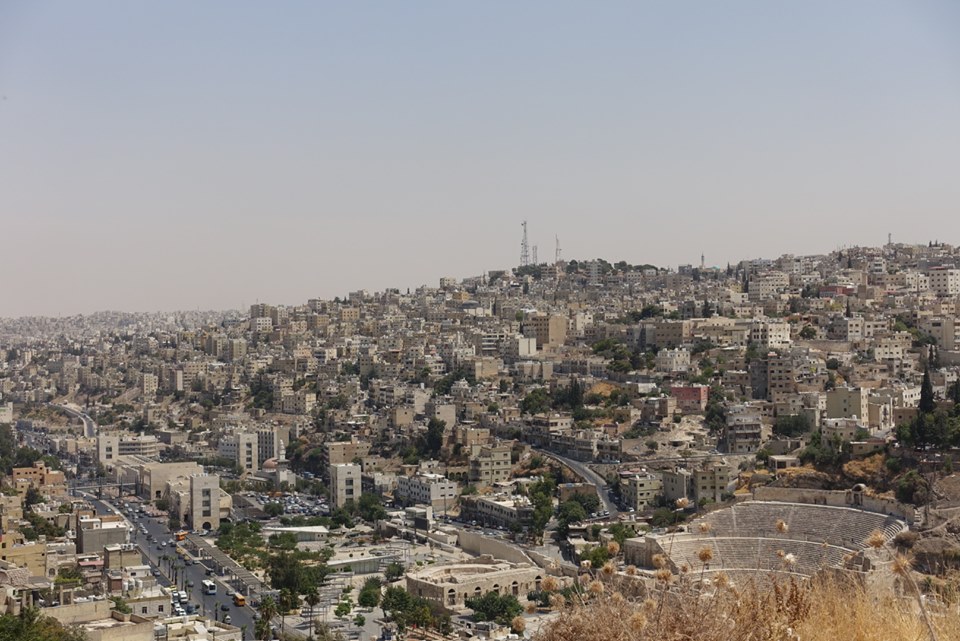
August 29, 2019 – What do you do when the stones you’re walking on contain 3,500 years of history? This is the thought I had while touring ancient Amman this week. The tour began with a trip to the Amman Citadel. The Citadel is considered the center of the city of Amman, and you can see why when you are there. From atop it’s proud perch, you get a completely panoramic view of the city and the original 7 hills it was built on (Amman was the city of 7 hills long before Rome!). One of my friends expressed his amazement at the view, commenting that it the city sprawls all the way to the horizon 360 degrees around you. Amman seems much bigger than New York from atop the Citadel.

Downtown Amman from the Amman Citadel

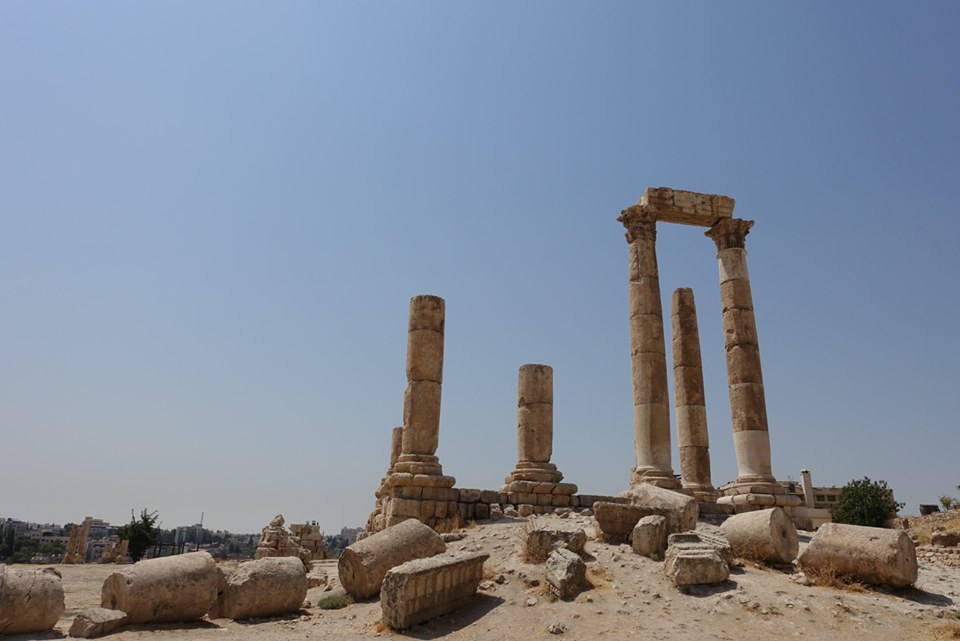
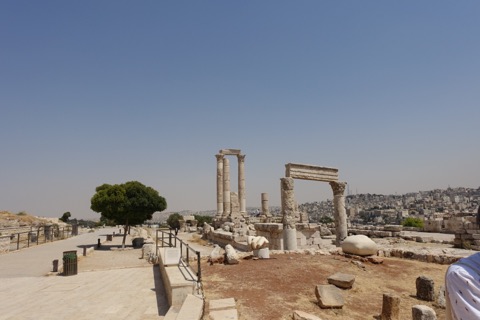
The Citadel’s history stretches all the way back to Neolithic times. One of the first major references to the Citadel and the city is in the Hebrew Bible (then called Rabbath-Ammon), serving as the capital of the Ammonites. Throughout history, Amman has been controlled by many civilizations: the Ammonites, Assyria, Persia, Greece, Rome, Byzantium, the Umayyad and Abbasid Caliphates, and many more. To this day, there are still remnants of these civilizations in the Amman Citadel. The Temple of Hercules was built in the second century CE by Governor Geminius Marcianus. The lavish Temple dedicated to the mythical hero contained a 13 meter high statue of Hercules, a colossal work of art for its time, but now all that remains are Herc’s massive fingers and elbow.

The ruins of the Temple of Hercules
Temple of Hercules from the Back with the remains of the statue’s fingers and elbow in front

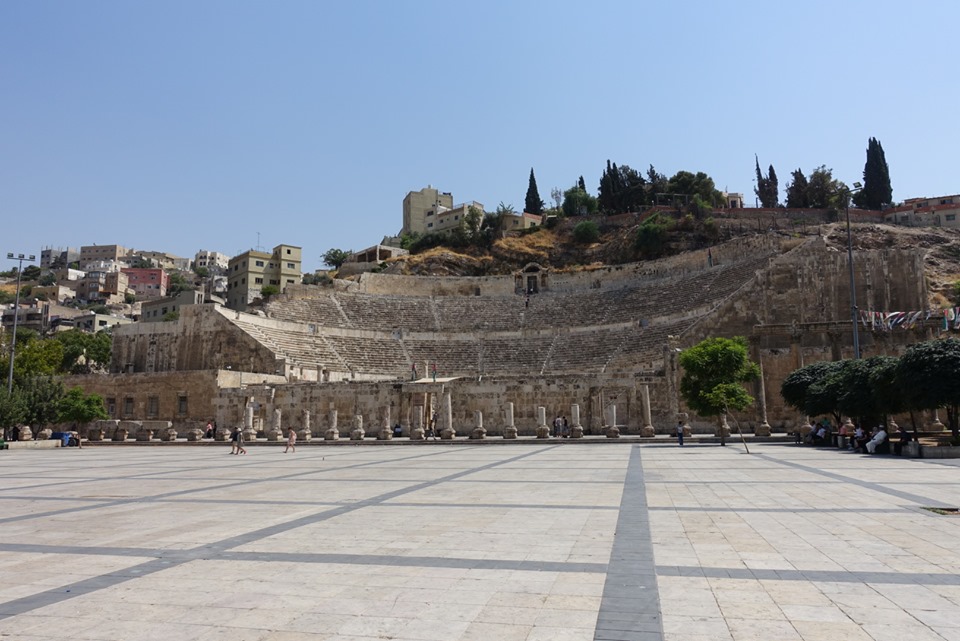
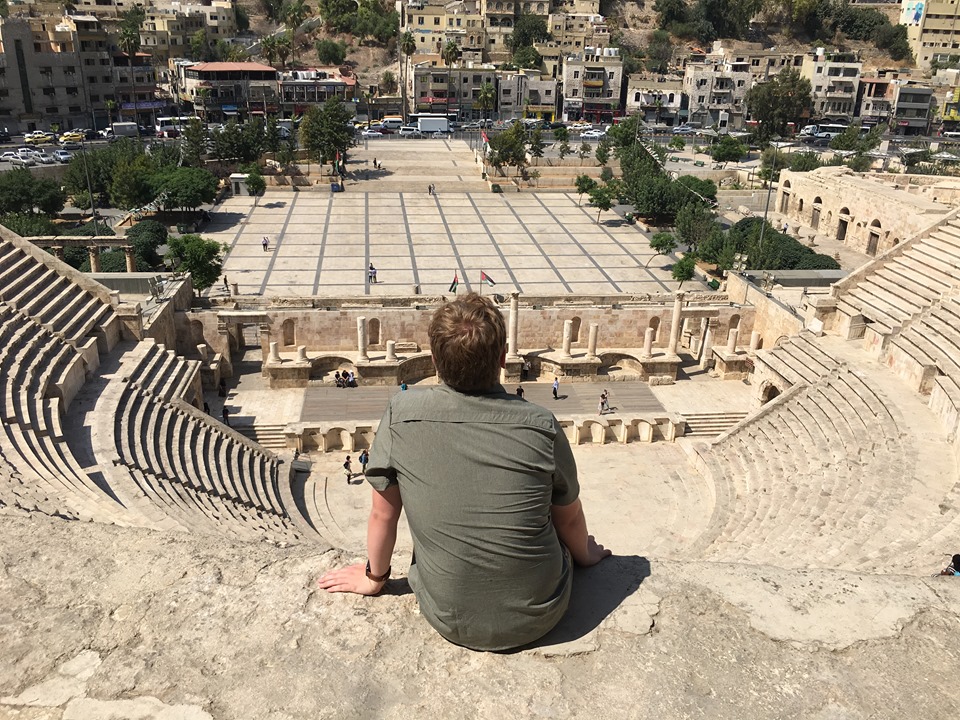
Beyond the Citadel lies the old Roman Amphitheater (built around the same time as the Temple of Hercules). Amman’s Amphitheater is truly an awe-inspiring structure. Climbing the marble steps all the way to the top row brought back memories of climbing Table Mountain with its uneven, uphill trails. Despite being almost 18 centuries old, the Amphitheater is still used as a summer concert venue!

The Roman Amphitheater
Why wouldn’t you climb all the way to the top?

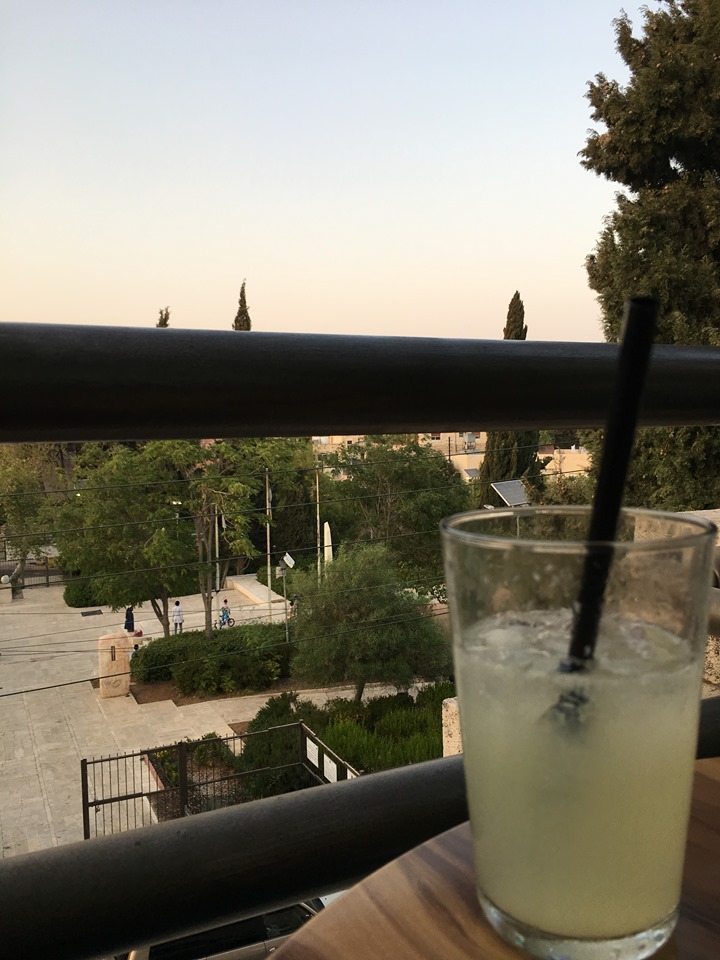
Juxtaposed with the city’s ancient history is a vibrant modern society with lots of cafés, museums, parks, and shops. One of my favorite spots is the Jungle Fever Coffee and Tea House in my neighborhood of Weibdeh. The cafe is on the top floor of the Jordan National Gallery of Fine Arts and overlooks a small park where people like to hang out and watch shows in the evenings. The outdoor seating has a great view of the neighborhood and the Great Mosque of King Abdullah I.

One of the best places in Amman to watch the sunset
The Great Mosque of King Abdullah I

Tomorrow starts the weekend (in most of the Arab World the Weekend is Friday/Saturday) and my friends and I plan on going to the سوق (“Souq” – an open air market where goods are sold; similar to a flea market). Stay tuned for more updates from الأردن!

– Matt
Design a site like this with WordPress.com
Get started